
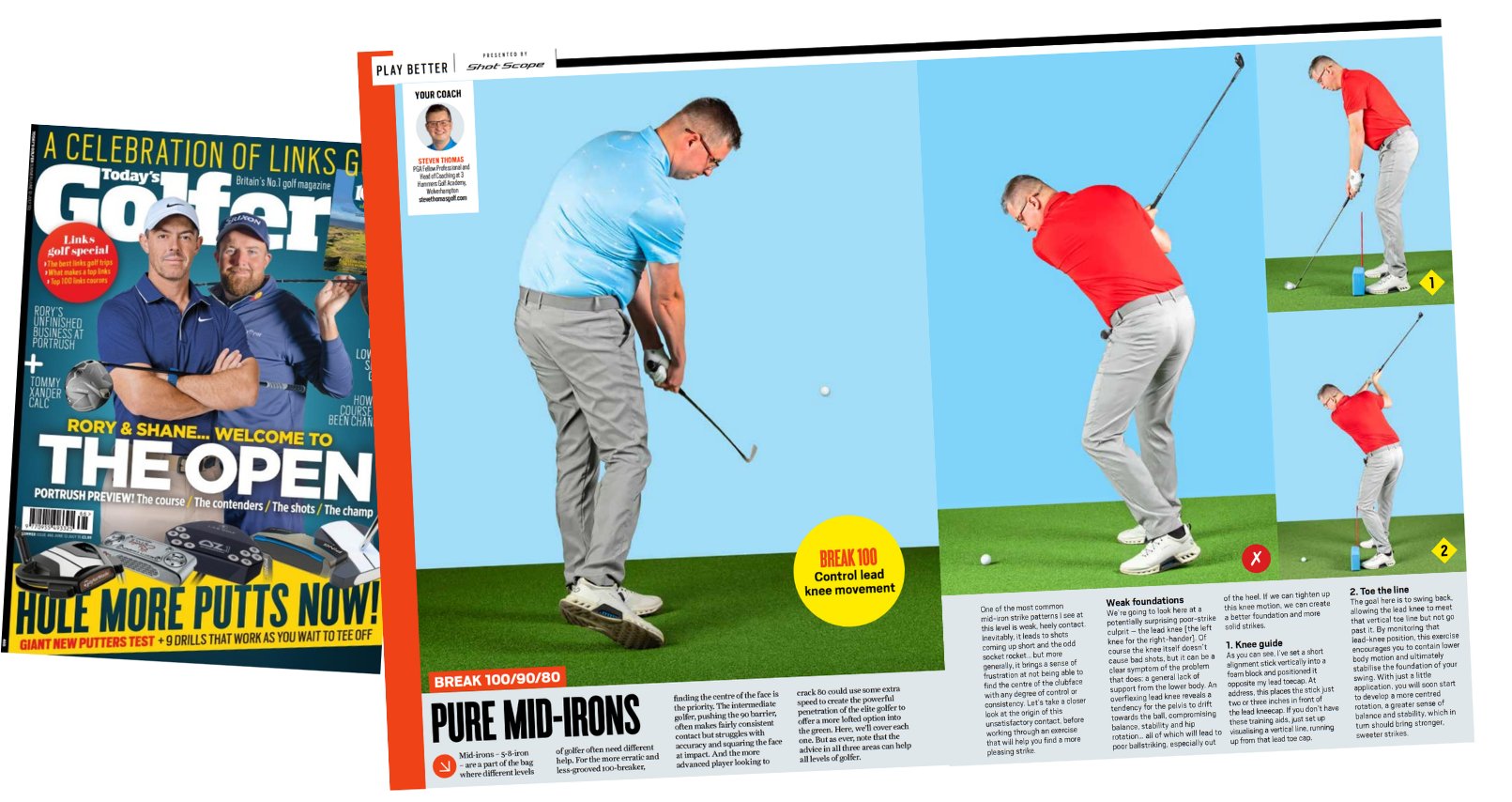
Pure mid-irons
Mid-irons – 5-8-iron – are a part of the bag where different levels of golfer often need different help.
For the more erratic and less-grooved 100-breaker, finding the centre of the face is the priority. The intermediate golfer, pushing the 90 barrier, often makes fairly consistent contact but struggles with Weak foundations accuracy and squaring the face at impact and the more advanced player looking to crack 80 could use some extra speed to create the powerful penetration of the elite golfer to offer a more lofted option into the green. Here, we’ll cover each one. But as ever, note that the advice in all three areas can help all levels of golfer.
One of the most common mid-iron strike patterns I see at this level is weak, heely contact. Inevitably, it leads to shots coming up short and the odd socket rocket… but more generally, it brings a sense of frustration at not being able to find the centre of the clubface with any degree of control or consistency. Let’s take a closer look at the origin of this unsatisfactory contact, before working through an exercise that will help you find a more pleasing strike.
Control lead knee movement
We’re going to look here at a potentially surprising poor strike culprit – the lead knee [the left knee for the right hander]. Of course the knee itself doesn’t cause bad shots, but it can be a clear symptom of the problem that does: a general lack of support from the lower body. An over flexing lead knee reveals a tendency for the pelvis to drift towards the ball, compromising balance, stability and hip rotation… all of which will lead to poor ball striking, especially out of the heel. If we can tighten up this knee motion, we can create a better foundation and more solid strikes.
Knee guide
As you can see, I’ve set a short alignment stick vertically into a foam block and positioned it opposite my lead toecap. At address, this places the stick just two or three inches in front of the lead kneecap. If you don’t have these training aids, just set up visualising a vertical line, running up from that lead toe cap.
Toe the line
The goal here is to swing back, allowing the lead knee to meet that vertical toe line but not go past it. By monitoring that lead-knee position, this exercise encourages you to contain lower body motion and ultimately stabilise the foundation of your swing. With just a little application, you will soon start to develop a more centred rotation, a greater sense of balance and stability, which in turn should bring stronger, sweeter strikes.
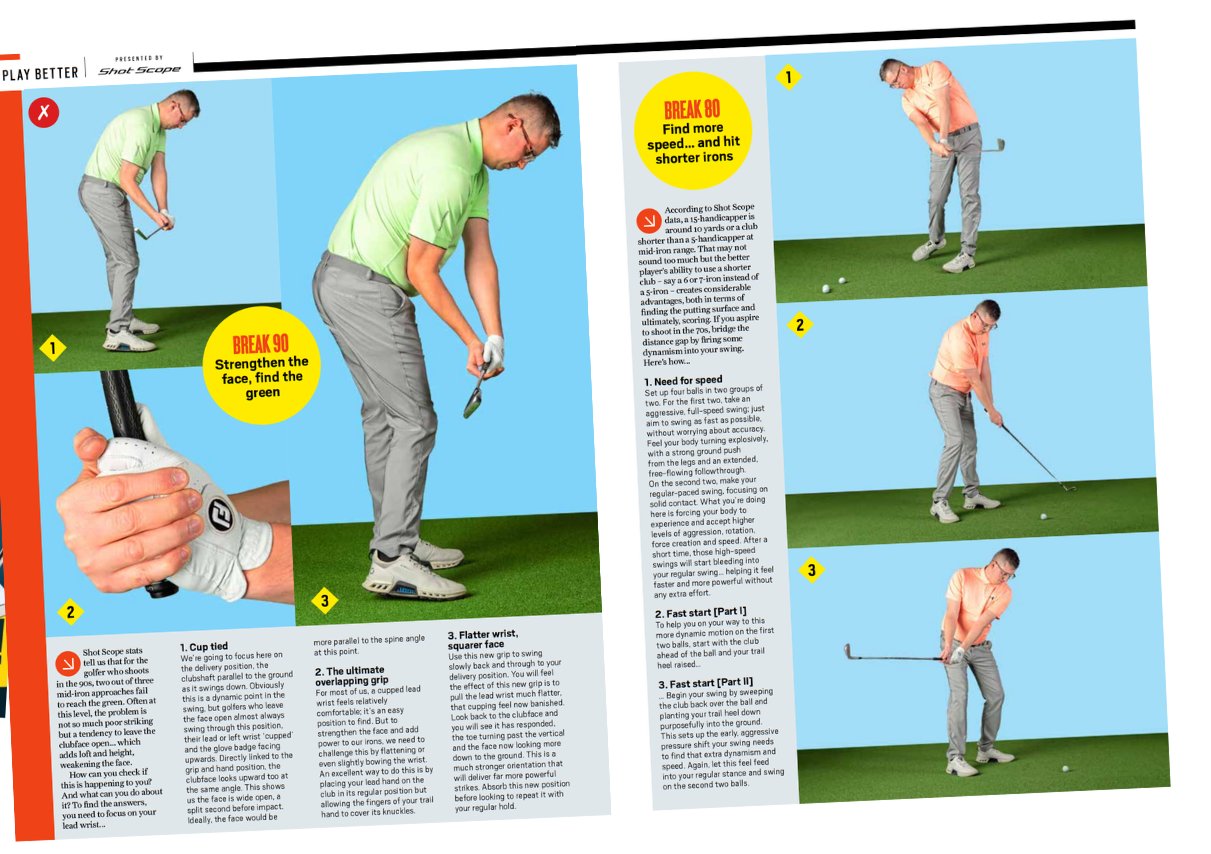
Strengthen the face, find the green
Shot Scope stats tell us that for the golfer who shoots in the 90s, two out of three mid-iron approaches fail to reach the green. Often at this level, the problem is not so much poor striking but a tendency to leave the clubface open… which adds loft and height, weakening the face.
How can you check if this is happening to you? And what can you do about it? To find the answers, you need to focus on your lead wrist..
Cup tied
Look at the delivery position when the clubshaft is parallel to the ground on the downswing. Golfers who leave the face open usually pass through this position with the lead wrist cupped and the glove badge facing upward. The clubface will also point upward, showing the face is open just before impact. Ideally the face should be closer to parallel with the spine angle.
The ultimate overlapping grip
For many golfers the cupped wrist feels natural. However flattening or slightly bowing the lead wrist strengthens the clubface and adds power. One way to achieve this is to place the lead hand normally on the club but allow the fingers of the trail hand to cover the knuckles of the lead hand.
Flatter wrist, squarer face
Use this new grip and swing slowly to the delivery position. You will feel the lead wrist flatten and the cupping disappear. The clubface will respond by rotating so the toe moves past vertical and the face points more toward the ground. This stronger face position helps produce more powerful strikes.
Once you understand the position, try repeating the feeling with your normal grip.
Find more speed… and hit shorter irons
Shot Scope data shows a 15 handicap golfer is around 10 yards shorter with mid irons than a 5 handicap golfer. That difference means the better player can use a shorter club such as a 6 or 7 iron instead of a 5 iron, which increases the chances of hitting the green and improving scoring.
To bridge the distance gap you need to add more dynamism and speed to the swing.

Steve Thomas
Steve is a PGA Fellow Coach, named in Today’s Golfer’s Top 50 UK Golf Coaches every year since 2020, and writes a monthly instruction feature for the magazine. A PGA Professional since 2011, he has coached more than 15,000 golfers and coaches in person in Shropshire and online.