
Thinned irons
Perhaps it should be no surprise that the thinned iron shot is one of golf’s most common miscues… across all standards of player. With the ball lying so tight to the turf, it’s only natural that we’ll tend to build in a bit of tuck, consciously or otherwise, to make sure we strike the small, hard ball before the large, squishy one. But while thin irons generally don’t wreak as much havoc as heavy ones, they can still cost you plenty of shots through lost yardage and greens well-protected to the front.
This is one area where different standards of player tend to thin the ball for different reasons… so make sure you’re focusing on the skill level and fault that’s relevant to you. But whatever your standard, building your awareness of the clubface and its positioning through the strike will help you find the sweetspot more often. Let’s get started…
Let the club do its job
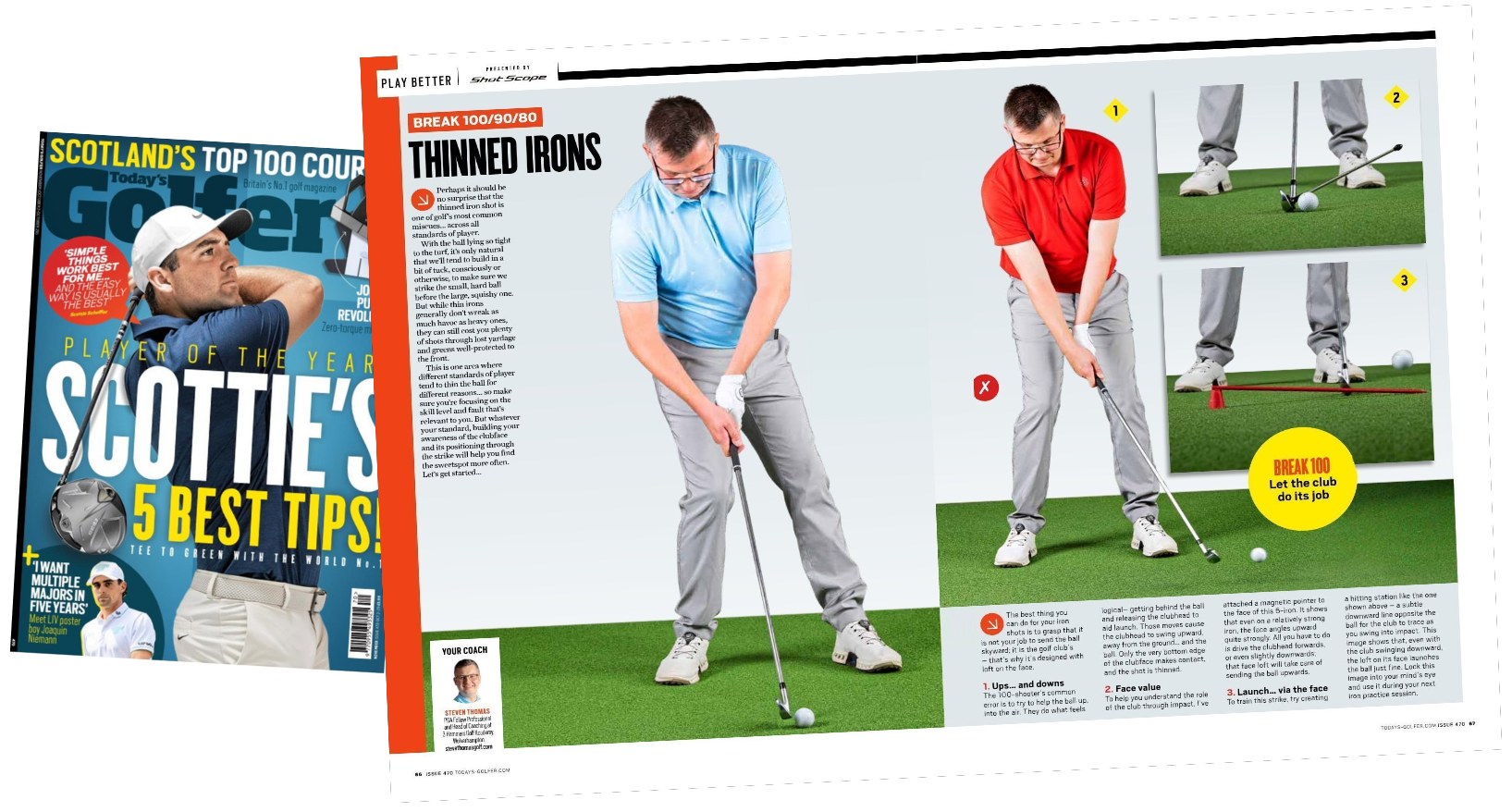
The best thing you can do for your iron shots is to grasp that it is not your job to send the ball skyward; it is the golf club’s – that’s why it’s designed with loft on the face.
Ups… and downs
The 100-shooter’s common error is to try to help the ball up, into the air. They do what feels logical– getting behind the ball and releasing the clubhead to aid launch. Those moves cause the clubhead to swing upward, away from the ground… and the ball. Only the very bottom edge of the clubface makes contact, and the shot is thinned.
Face value
To help you understand the role of the club through impact, I’ve attached a magnetic pointer to the face of this 6-iron. It shows that even on a relatively strong iron, the face angles upward quite strongly. All you have to do is drive the clubhead forwards, or even slightly downwards; that face loft will take care of sending the ball upwards.
Launch… via the face
To train this strike, try creating a hitting station like the one shown above – a subtle downward line opposite the ball for the club to trace as you swing into impact. This image shows that, even with the club swinging downward, the loft on its face launches the ball just fine. Lock this image into your mind’s eye and use it during your next iron practice session.
Get rid of tension
Tight… and short
In this article, we are dealing with attack angle issues for both the 100 and 80-breaker… and attack angle certainly needs to be carefully monitored by the 90-breaker to ensure you are not swinging excessively upward or downward. But at this level we are going to focus on another, less obvious issue that can lead to thin, weak contact – tension. Let’s take a look at how getting tight can compromise strike on a regular basis…
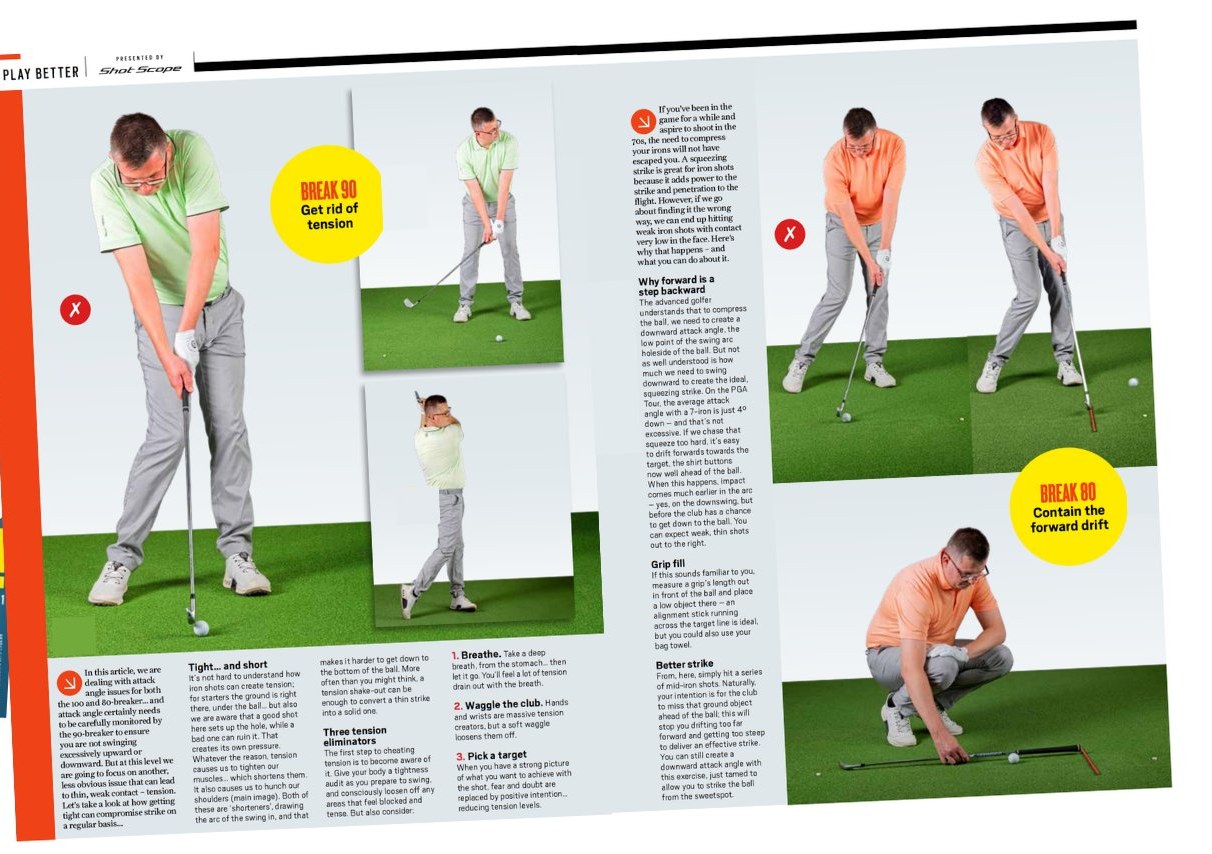
It’s not hard to understand how iron shots can create tension; for starters the ground is right there, under the ball… but also we are aware that a good shot here sets up the hole, while a bad one can ruin it. That creates its own pressure. Whatever the reason, tension causes us to tighten our muscles… which shortens them. It also causes us to hunch our shoulders (main image). Both of these are ‘shorteners’, drawing the arc of the swing in, and that makes it harder to get down to the bottom of the ball. More often than you might think, a tension shake-out can be enough to convert a thin strike into a solid one.
Three tension eliminators
The first step to cheating
tension is to become aware of it. Give your body a tightness audit as you prepare to swing, and consciously loosen off any areas that feel blocked and tense. But also consider:
Breathe
Take a deep breath, from the stomach… then let it go. You’ll feel a lot of tension drain out with the breath.
Waggle the club
Hands and wrists are massive tension creators, but a soft waggle loosens them off.
Pick a target
When you have a strong picture of what you want to achieve with the shot, fear and doubt are replaced by positive intention… reducing tension levels.
Contain the forward drift
Why forward is a step backward
If you’ve been in the game for a while and aspire to shoot in the 70s, the need to compress your irons will not have escaped you. A squeezing strike is great for iron shots because it adds power to the strike and penetration to the flight. However, if we go about finding it the wrong way, we can end up hitting weak iron shots with contact very low in the face. Here’s why that happens – and what you can do about it.
The advanced golfer understands that to compress the ball, we need to create a downward attack angle, the low point of the swing arc holeside of the ball. But not as well understood is how much we need to swing downward to create the ideal, squeezing strike. On the PGA Tour, the average attack angle with a 7-iron is just 4º down – and that’s not excessive. If we chase that squeeze too hard, it’s easy to drift forwards towards the target, the shirt buttons now well ahead of the ball. When this happens, impact comes much earlier in the arc – yes, on the downswing, but before the club has a chance to get down to the ball. You can expect weak, thin shots out to the right.
Grip fill
If this sounds familiar to you, measure a grip’s length out in front of the ball and place a low object there – an alignment stick running across the target line is ideal, but you could also use your bag towel.
Better strike
From here, simply hit a series of mid-iron shots. Naturally, your intention is for the club to miss that ground object ahead of the ball; this will stop you drifting too far forward and getting too steep to deliver an effective strike. You can still create a downward attack angle with this exercise, just tamed to allow you to strike the ball from the sweetspot.

Steve Thomas
Steve is a PGA Fellow Coach, named in Today’s Golfer’s Top 50 UK Golf Coaches every year since 2020, and writes a monthly instruction feature for the magazine. A PGA Professional since 2011, he has coached more than 15,000 golfers and coaches in person in Shropshire and online.