
Better driving
‘Better’ driving means different things to different people. The advanced golfer typically wants to add distance for shorter approaches and more birdie opportunities. At the other end of the scale, the beginner is just looking to make reasonable contact and to keep the ball out of trouble, so consistency and control tend to be the priorities. In between, by far the most common issue for the game improver is a cut or slice, so generally what’s needed here is some reducing of the curvature without sacrificing any distance.
We will deal with each issue in turn here, starting with the 100-breaker as usual. Of course your own driving needs may not reflect these generalisations, so take a look at the tips that are most relevant to you. But as always, any golfer can benefit from all three approaches detailed here, so don’t forget the other two!
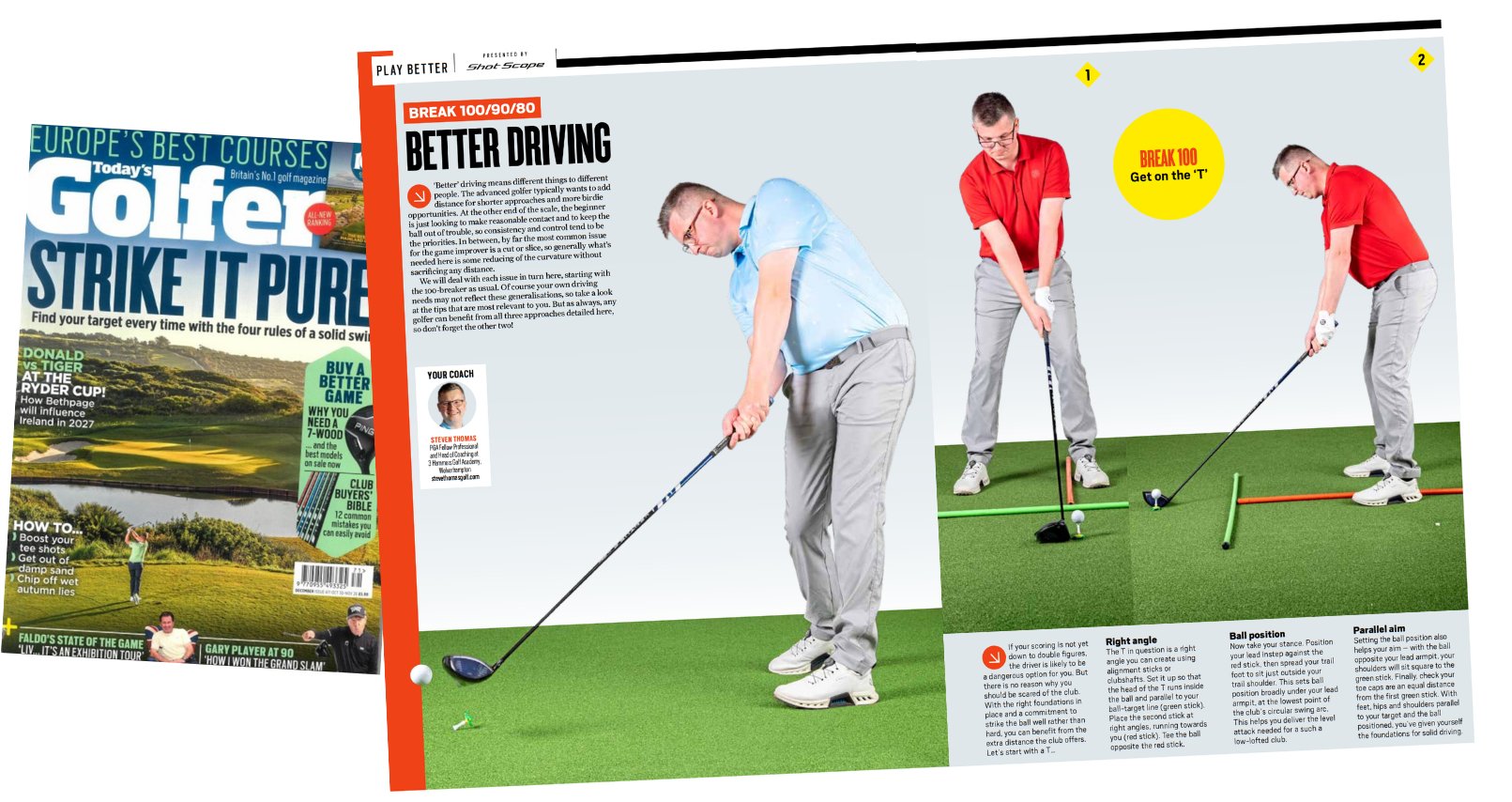
Get on the ‘T’
If your scoring is not yet down to double figures, the driver is likely to be a dangerous option for you. But there is no reason why you should be scared of the club. With the right foundations in place and a commitment to strike the ball well rather than hard, you can benefit from the extra distance the club offers. Let’s start with a T…
Right angle
The T in question is a right angle you can create using alignment sticks or clubshafts. Set it up so that the head of the T runs inside the ball and parallel to your ball-target line (green stick). Place the second stick at right angles, running towards you (red stick). Tee the ball opposite the red stick.
Ball position
Now take your stance. Position your lead instep against the red stick, then spread your trail foot to sit just outside your trail shoulder. This sets ball position broadly under your lead armpit, at the lowest point of the club’s circular swing arc. This helps you deliver the level attack needed for such a low-lofted club.
Parallel aim
Setting the ball position also helps your aim – with the ball opposite your lead armpit, your shoulders will sit square to the green stick. Finally, check your toe caps are an equal distance from the first green stick. With feet, hips and shoulders parallel to your target and the ball positioned, you’ve given yourself the foundations for solid driving.
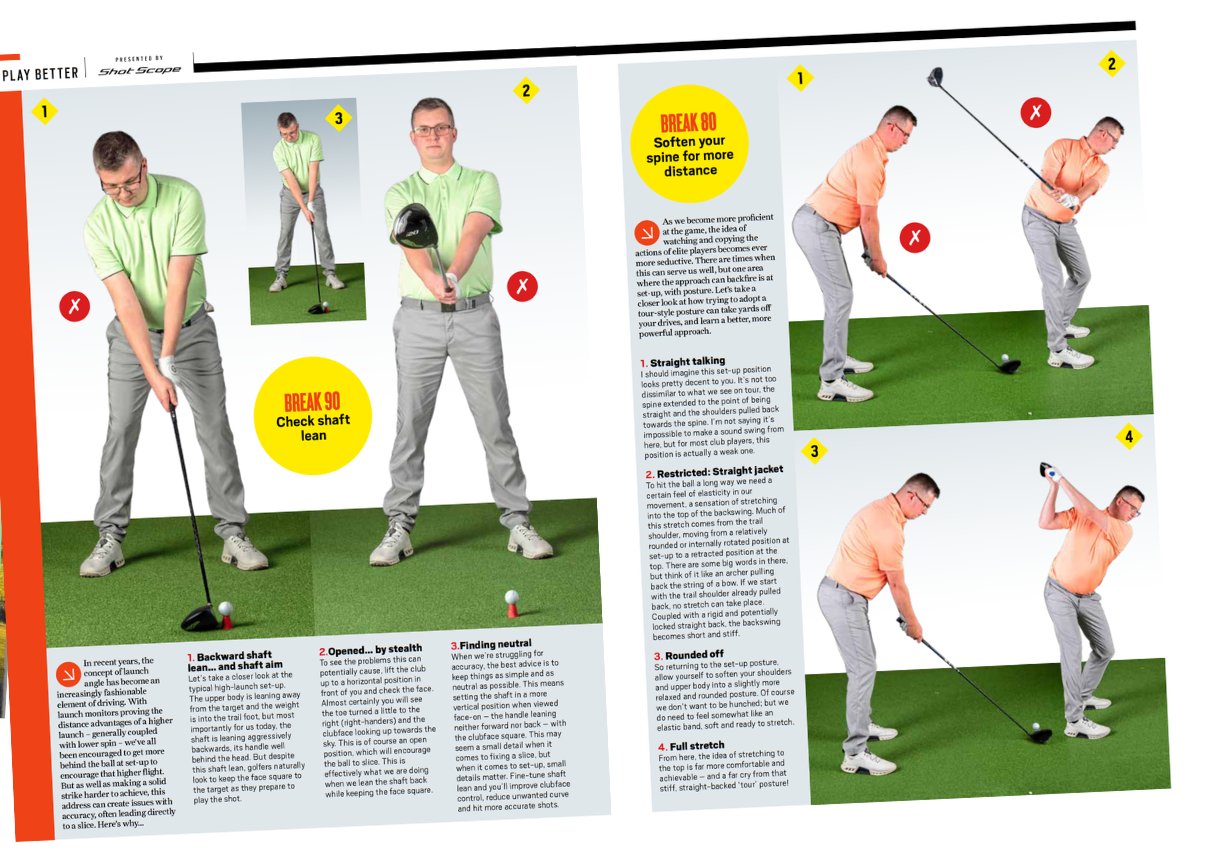
Check shaft lean
In recent years, the concept of launch angle has become an increasingly fashionable element of driving. With launch monitors proving the distance advantages of a higher launch – generally coupled with lower spin – we’ve all been encouraged to get more behind the ball at set-up to encourage that higher flight. But as well as making a solid strike harder to achieve, this address can create issues with accuracy, often leading directly to a slice. Here’s why…
Backward shaft lean… and shaft aim
Let’s take a closer look at the typical high-launch set-up. The upper body is leaning away from the target and the weight is into the trail foot, but most importantly for us today, the shaft is leaning aggressively backwards, its handle well behind the head. But despite this shaft lean, golfers naturally look to keep the face square to the target as they prepare to play the shot.
Opened… by stealth
To see the problems this can potentially cause, lift the club up to a horizontal position in front of you and check the face. Almost certainly you will see the toe turned a little to the right (right-handers) and the clubface looking up towards the sky. This is of course an open position, which will encourage the ball to slice. This is effectively what we are doing when we lean the shaft back while keeping the face square.
Finding neutral
When we’re struggling for accuracy, the best advice is to keep things as simple and as neutral as possible. This means setting the shaft in a more vertical position when viewed face-on – the handle leaning neither forward nor back – with the clubface square. This may seem a small detail when it comes to fixing a slice, but when it comes to set-up, small details matter. Fine-tune shaft lean and you’ll improve clubface control, reduce unwanted curve and hit more accurate shots.
Soften your spine for more distance
As we become more proficient at the game, the idea of watching and copying the actions of elite players becomes ever more seductive. There are times when this can serve us well, but one area where the approach can backfire is at set-up, with posture. Let’s take a closer look at how trying to adopt a tour-style posture can take yards off your drives, and learn a better, more powerful approach.
Straight talking
I should imagine this set-up position looks pretty decent to you. It’s not too dissimilar to what we see on tour, the spine extended to the point of being straight and the shoulders pulled back towards the spine. I’m not saying it’s impossible to make a sound swing from here, but for most club players, this position is actually a weak one.
Restricted: Straight jacket
I should imagine this set-up position looks pretty decent to you. It’s not too dissimilar to what we see on tour, the spine extended to the point of being straight and the shoulders pulled back towards the spine. I’m not saying it’s impossible to make a sound swing from here, but for most club players, this position is actually a weak one.
Rounded off
So returning to the set-up posture, allow yourself to soften your shoulders and upper body into a slightly more relaxed and rounded posture. Of course we don’t want to be hunched; but we do need to feel somewhat like an elastic band, soft and ready to stretch.
Full stretch
From here, the idea of stretching to the top is far more comfortable and achievable – and a far cry from that stiff, straight-backed ‘tour’ posture!

Steve Thomas
Steve is a PGA Fellow Coach, named in Today’s Golfer’s Top 50 UK Golf Coaches every year since 2020, and writes a monthly instruction feature for the magazine. A PGA Professional since 2011, he has coached more than 15,000 golfers and coaches in person in Shropshire and online.