
Duffed chips
Let’s get one thing straight from the start: we cannot ever eliminate this infuriating shot from our game for good. As long as the ball is lying on the turf and the clubface is travelling at a relatively slow speed, damaging ground-first contact will always be a possibility. Even the best players in the world catch one a little heavy from time to time. However, what we can do is develop a technique that makes sure those moments are fewer and further between. Because different standards of golfer habitually duff chips for different reasons, we need to group the most effective solutions by skill level. An understanding of your own game and action will help guide you to your own best approach, but as ever, all three elements detailed here will help your chipping. We start with the golfer looking break that 100 barrier…
Ditch the ‘hit down’ mentality
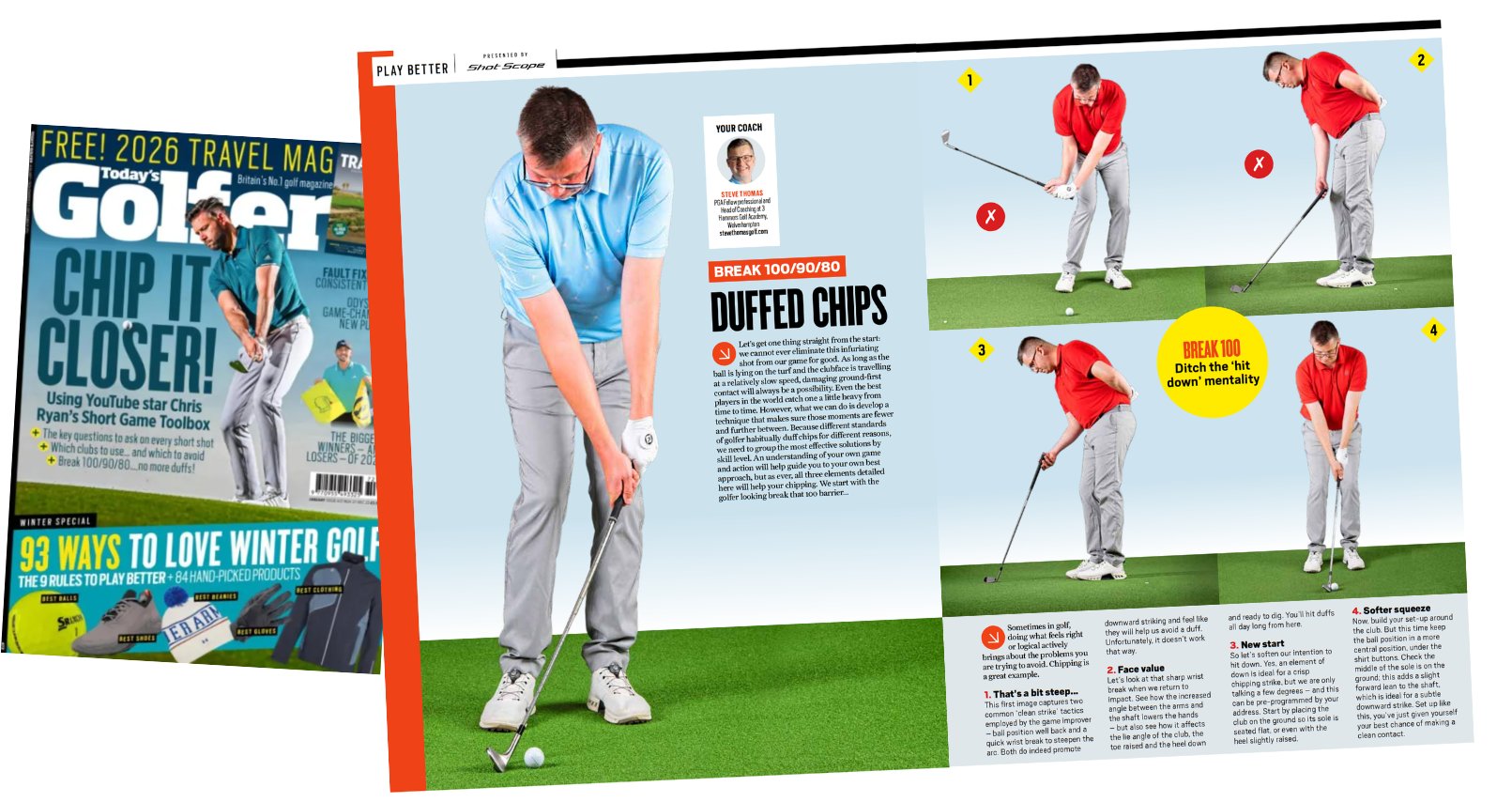
Sometimes in golf, doing what feels right or logical actively brings about the problems you are trying to avoid. Chipping is a great example.
That’s a bit steep…
This first image captures two common ‘clean strike’ tactics employed by the game improver – ball position well back and a quick wrist break to steepen the arc. Both do indeed promote downward striking and feel like they will help us avoid a duff. Unfortunately, it doesn’t work that way.
Face value
Let’s look at that sharp wrist break when we return to impact. See how the increased angle between the arms and the shaft lowers the hands – but also see how it affects the lie angle of the club, the toe raised and the heel down and ready to dig. You’ll hit duffs all day long from here.
New start
So let’s soften our intention to hit down. Yes, an element of down is ideal for a crisp chipping strike, but we are only talking a few degrees – and this can be pre-programmed by your address. Start by placing the club on the ground so its sole is seated flat, or even with the heel slightly raised.
Softer squeeze
Now, build your set-up around the club. But this time keep the ball position in a more central position, under the shirt buttons. Check the middle of the sole is on the ground; this adds a slight forward lean to the shaft, which is ideal for a subtle downward strike. Set up like this, you’ve just given yourself your best chance of making a clean contact.
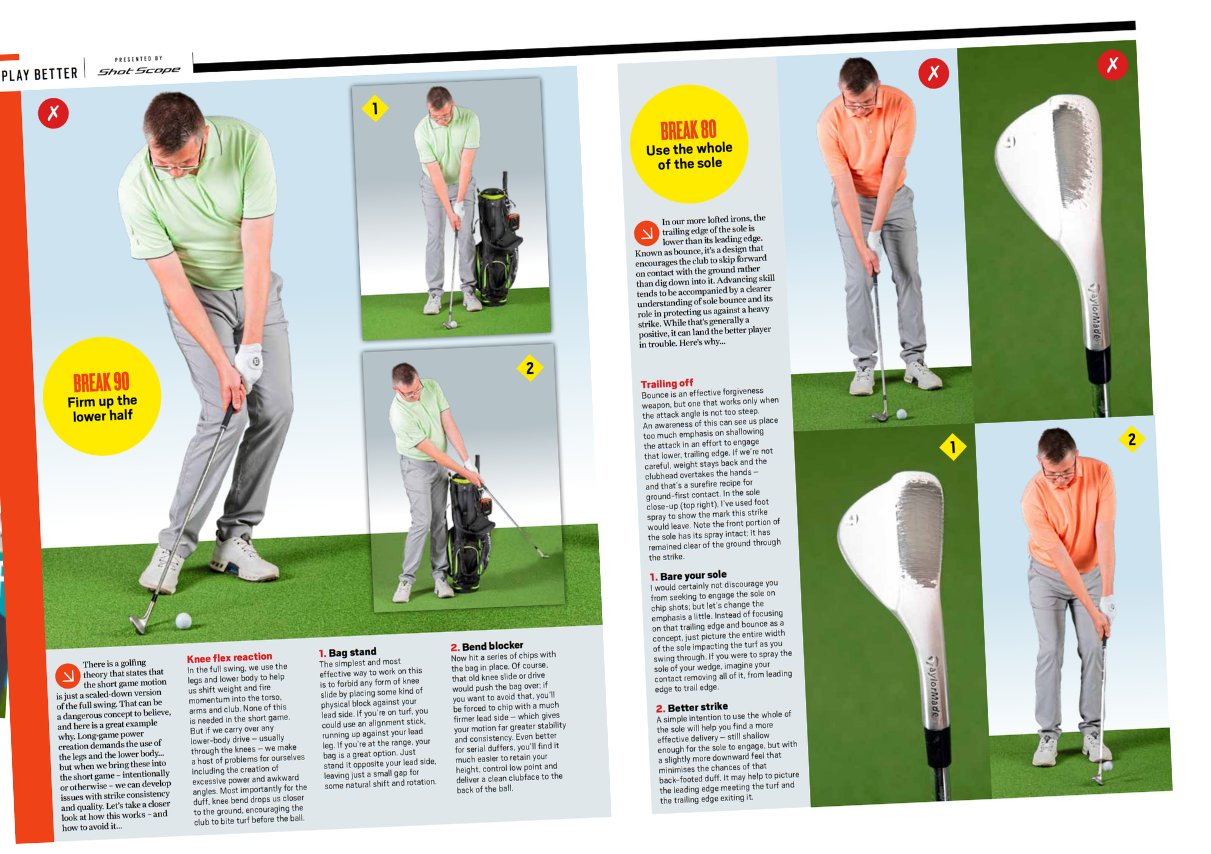
Firm up the lower half
There is a golfing theory that states that the short game motion is just a scaled-down version of the full swing. That can be a dangerous concept to believe, and here is a great example why. Long-game power creation demands the use of the legs and the lower body… but when we bring these into the short game – intentionally or otherwise – we can develop issues with strike consistency and quality. Let’s take a closer look at how this works – and how to avoid it…
Knee flex reaction
In the full swing, we use the legs and lower body to help us shift weight and fire momentum into the torso, arms and club. None of this is needed in the short game. But if we carry over any lower-body drive – usually through the knees – we make a host of problems for ourselves including the creation of excessive power and awkward angles. Most importantly for the duff, knee bend drops us closer to the ground, encouraging the club to bite turf before the ball.
Bag Stand
The simplest and most effective way to work on this is to forbid any form of knee slide by placing some kind of physical block against your lead side. If you’re on turf, you could use an alignment stick, running up against your lead leg. If you’re at the range, your bag is a great option. Just stand it opposite your lead side, leaving just a small gap for some natural shift and rotation.
Bend blocker
Now hit a series of chips with the bag in place. Of course, that old knee slide or drive would push the bag over; if you want to avoid that, you’ll be forced to chip with a much firmer lead side – which gives your motion far greater stability and consistency. Even better for serial duffers, you’ll find it much easier to retain your height, control low point and deliver a clean clubface to the back of the ball.
Use the whole of the sole
In our more lofted irons, the trailing edge of the sole is lower than its leading edge. Known as bounce, it’s a design that encourages the club to skip forward on contact with the ground rather than dig down into it. Advancing skill tends to be accompanied by a clearer understanding of sole bounce and its role in protecting us against a heavy strike. While that’s generally a positive, it can land the better player in trouble. Here’s why…
Trailing off
Bounce is an effective forgiveness weapon, but one that works only when the attack angle is not too steep. An awareness of this can see us place too much emphasis on shallowing the attack in an effort to engage that lower, trailing edge. If we’re not careful, weight stays back and the clubhead overtakes the hands – and that’s a surefire recipe for ground-first contact. In the sole close-up (top right), I’ve used foot spray to show the mark this strike would leave. Note the front portion of the sole has its spray intact; it has remained clear of the ground through the strike.
Bare your sole
I would certainly not discourage you from seeking to engage the sole on chip shots; but let’s change the emphasis a little. Instead of focusing on that trailing edge and bounce as a concept, just picture the entire width of the sole impacting the turf as you swing through. If you were to spray the sole of your wedge, imagine your contact removing all of it, from leading edge to trail edge.
Better strike
A simple intention to use the whole of the sole will help you find a more effective delivery – still shallow enough for the sole to engage, but with a slightly more downward feel that minimises the chances of that back-footed duff. It may help to picture the leading edge meeting the turf and the trailing edge exiting it.

Steve Thomas
Steve is a PGA Fellow Coach, named in Today’s Golfer’s Top 50 UK Golf Coaches every year since 2020, and writes a monthly instruction feature for the magazine. A PGA Professional since 2011, he has coached more than 15,000 golfers and coaches in person in Shropshire and online.