
Strong fairway woods
With the ability to eat up the yards on long par 4s and perhaps even set up the odd eagle attempt on par 5s, the fairway wood has the potential to be a really important ally. However, the difficulties of applying such a large-headed and long-shafted club to a ball lying tight to the turf ensure this option is often overlooked, in favour of a more hittable but less productive option. At all levels of the game, if we can improve our confidence with the fairway wood we can reap the scoring benefits that come from getting as close to the green as possible with those long approaches. Different abilities typically need different approaches – so let’s see how this breaks down for the golfer aspiring to shoot in the 90s, 80s and 70s.
Train low point control for a solid strike
Sweeping strike
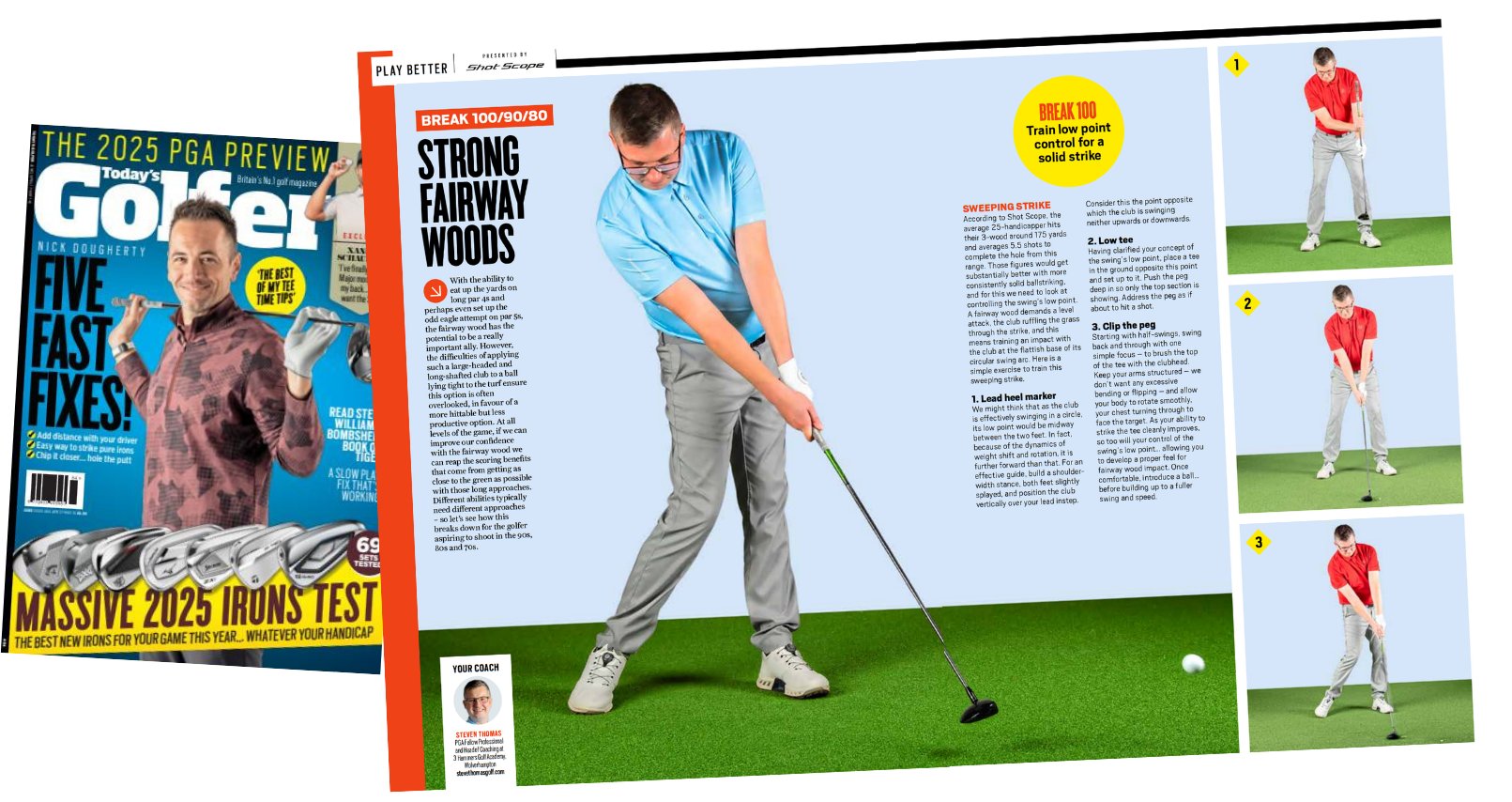
According to Shot Scope, the average 25-handicapper hits their 3-wood around 175 yards and averages 5.5 shots to complete the hole from this range. Those figures would get substantially better with more consistently solid ballstriking, and for this we need to look at controlling the swing’s low point. A fairway wood demands a level attack, the club ruffling the grass through the strike, and this means training an impact with the club at the flattish base of its circular swing arc. Here is a simple exercise to train this sweeping strike.
Lead heel marker
We might think that as the club is effectively swinging in a circle, its low point would be midway between the two feet. In fact, because of the dynamics of weight shift and rotation, it is further forward than that. For an effective guide, build a shoulder-width stance, both feet slightly splayed, and position the club vertically over your lead instep. Consider this the point opposite which the club is swinging neither upwards or downwards.
Low tee
Having clarified your concept of the swing’s low point, place a tee in the ground opposite this point and set up to it. Push the peg deep in so only the top section is showing. Address the peg as if about to hit a shot.
Clip the peg
Starting with half-swings, swing back and through with one simple focus – to brush the top of the tee with the clubhead. Keep your arms structured – we don’t want any excessive bending or flipping – and allow your body to rotate smoothly, your chest turning through to face the target. As your ability to strike the tee cleanly improves, so too will your control of the swing’s low point… allowing you to develop a proper feel for fairway wood impact. Once comfortable, introduce a ball… before building up to a fuller swing and speed.
Avoid the shallow-to-steep pattern
The data shows us that the lack of distance that dogs the 100-shooter remains a problem at 20-handicap level, a standard where golfers are aspiring to shoot in the 80s. But while the 100-breaker focus should be on solid contact, the slightly more advanced 90-breaker would do well to address the timing of the strike, and delivering speed at the right time – a weak spot with longer fairway woods that causes both speed and contact issues. Let’s take a closer look.
THROWING IT AWAY
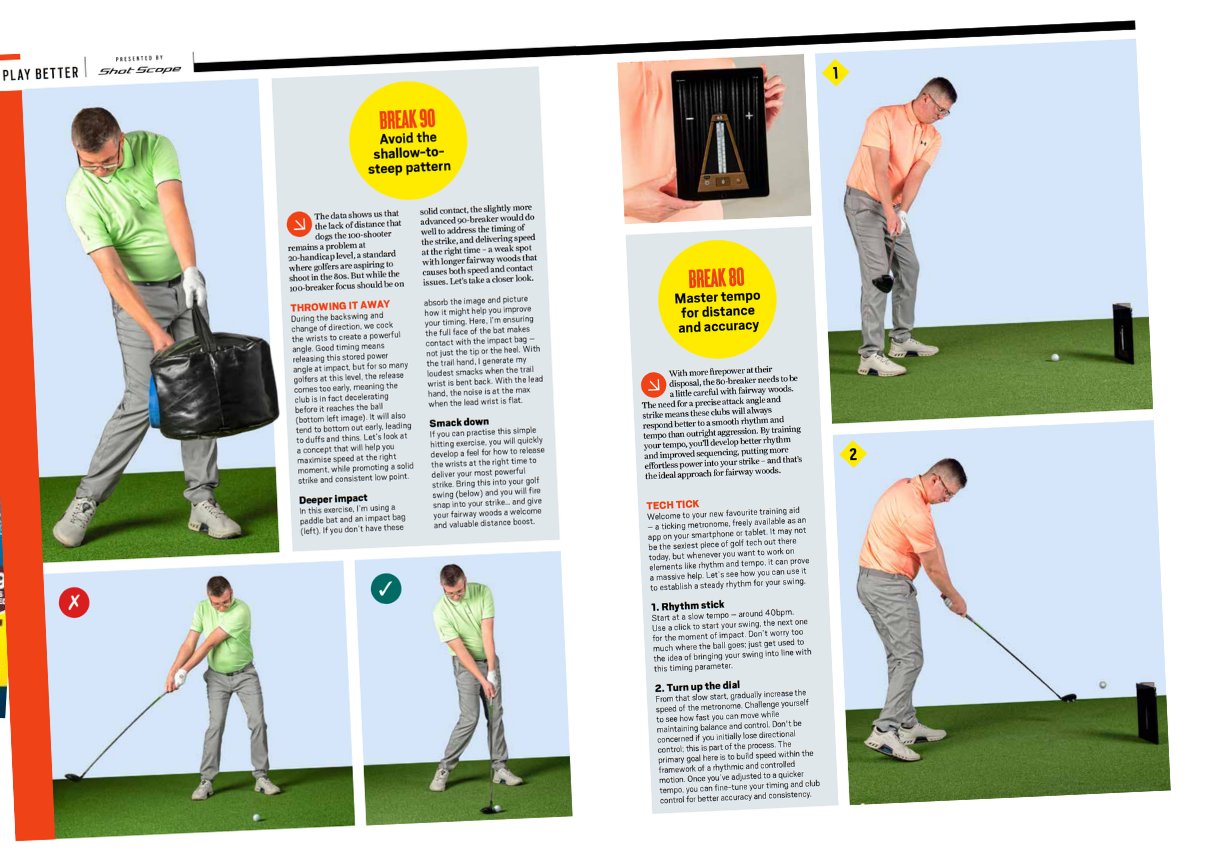
During the backswing and change of direction, we cock the wrists to create a powerful angle. Good timing means releasing this stored power angle at impact, but for so many golfers at this level, the release comes too early, meaning the club is in fact decelerating before it reaches the ball (bottom left image). It will also tend to bottom out early, leading to duffs and thins. Let’s look at a concept that will help you maximise speed at the right moment, while promoting a solid strike and consistent low point.
Deeper impact
In this exercise, I’m using a paddle bat and an impact bag (left). If you don’t have these absorb the image and picture how it might help you improve your timing. Here, I’m ensuring the full face of the bat makes contact with the impact bag – not just the tip or the heel. With the trail hand, I generate my loudest smacks when the trail wrist is bent back. With the lead hand, the noise is at the max when the lead wrist is flat.
Smack down
If you can practise this simple hitting exercise, you will quickly develop a feel for how to release the wrists at the right time to deliver your most powerful strike. Bring this into your golf swing (below) and you will fire snap into your strike… and give your fairway woods a welcome and valuable distance boost.
Master tempo for distance and accuracy
With more firepower at their disposal, the 80-breaker needs to be a little careful with fairway woods. The need for a precise attack angle and strike means these clubs will always respond better to a smooth rhythm and tempo than outright aggression. By training your tempo, you’ll develop better rhythm and improved sequencing, putting more effortless power into your strike – and that’s the ideal approach for fairway woods.
Tech tick
Welcome to your new favourite training aid – a ticking metronome, freely available as an app on your smartphone or tablet. It may not be the sexiest piece of golf tech out there today, but whenever you want to work on elements like rhythm and tempo, it can prove a massive help. Let’s see how you can use it to establish a steady rhythm for your swing.
Rhythm stick
Start at a slow tempo – around 40bpm. Use a click to start your swing, the next one for the moment of impact. Don’t worry too much where the ball goes; just get used to the idea of bringing your swing into line with this timing parameter.
Turn up the dial
From that slow start, gradually increase the speed of the metronome. Challenge yourself to see how fast you can move while maintaining balance and control. Don’t be concerned if you initially lose directional control; this is part of the process. The primary goal here is to build speed within the framework of a rhythmic and controlled motion. Once you’ve adjusted to a quicker tempo, you can fine-tune your timing and club control for better accuracy and consistency.

Steve Thomas
Steve is a PGA Fellow Coach, named in Today’s Golfer’s Top 50 UK Golf Coaches every year since 2020, and writes a monthly instruction feature for the magazine. A PGA Professional since 2011, he has coached more than 15,000 golfers and coaches in person in Shropshire and online.