
Pure short irons
In theory, your short irons – 9-iron, pitch and gap wedges – should be among the easier clubs in your bag to hit. Their high lofts mean getting the ball up should not prove to be a problem, and that any excessive spin does not curve the ball too far off line. But against this, we can balance the increasingly specific tasks these clubs are being asked to perform. Length or line alone is no good; short irons need both if they are to be effective, and that means our control of power and accuracy must shift up a notch.
Focusing on strike quality, harnessing power and face aim control, this article gives you three avenues of exploration for three different levels of golfer. By all means read the advice for the level that applies to you first… but don’t ignore the other two; they have the potential to prove just as useful.
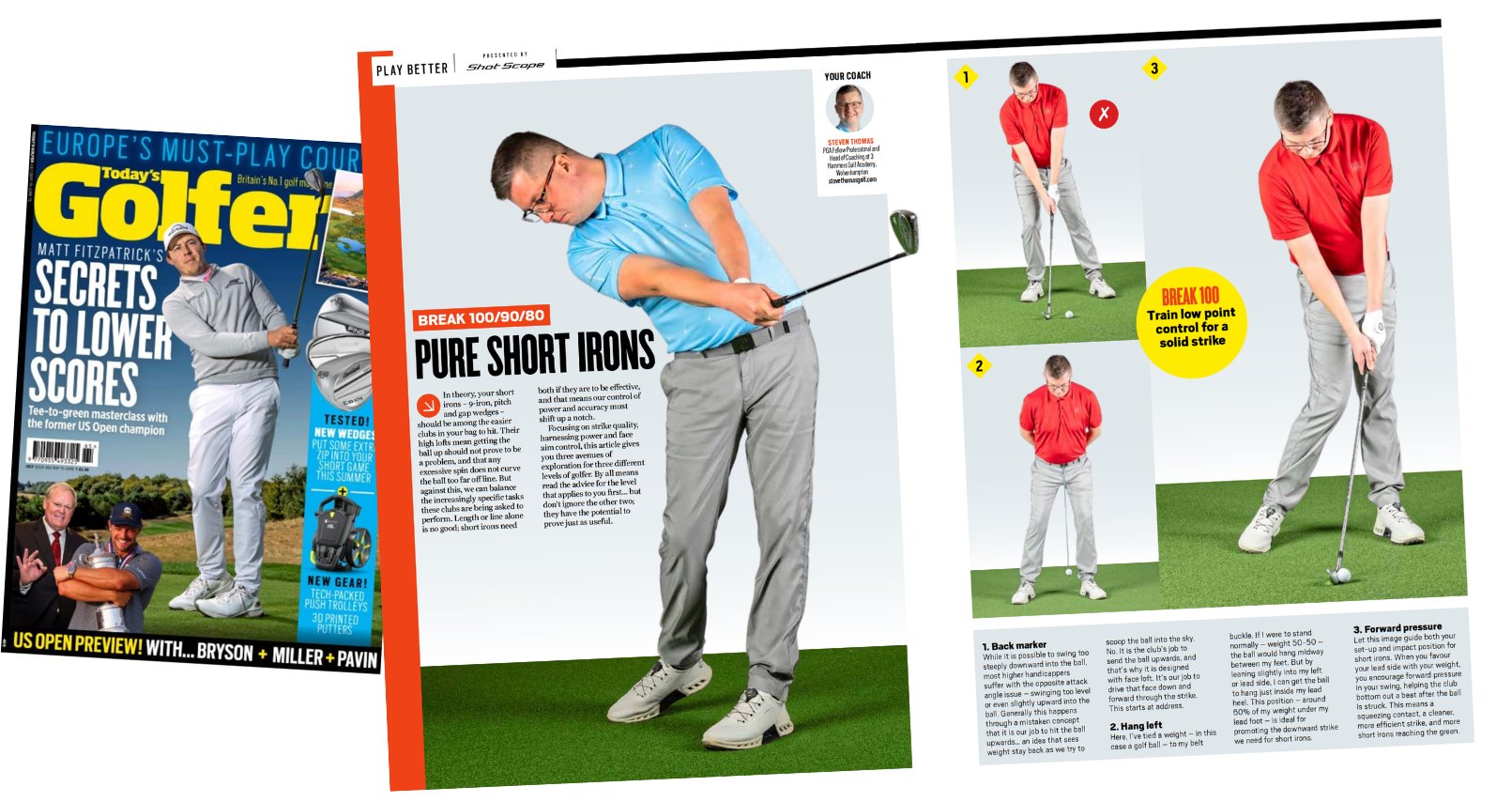
Train low point control for a solid strike
Back marker
While it is possible to swing too steeply downward into the ball, most higher handicappers suffer with the opposite attack angle issue – swinging too level or even slightly upward into the ball. Generally this happens through a mistaken concept that it is our job to hit the ball upwards… an idea that sees weight stay back as we try to scoop the ball into the sky.
No. It is the club’s job to send the ball upwards, and that’s why it is designed with face loft. It’s our job to drive that face down and forward through the strike. This starts at address.
Hang left
Here, I’ve tied a weight – in this case a golf ball – to my belt buckle. If I were to stand normally – weight 50-50 – the ball would hang midway between my feet. But by leaning slightly into my left or lead side, I can get the ball to hang just inside my lead heel. This position – around 60% of my weight under my lead foot – is ideal for promoting the downward strike we need for short irons.
Forward pressure
Let this image guide both your set-up and impact position for short irons. When you favour your lead side with your weight, you encourage forward pressure in your swing, helping the club bottom out a beat after the ball is struck. This means a squeezing contact, a cleaner, more efficient strike, and more short irons reaching the green.
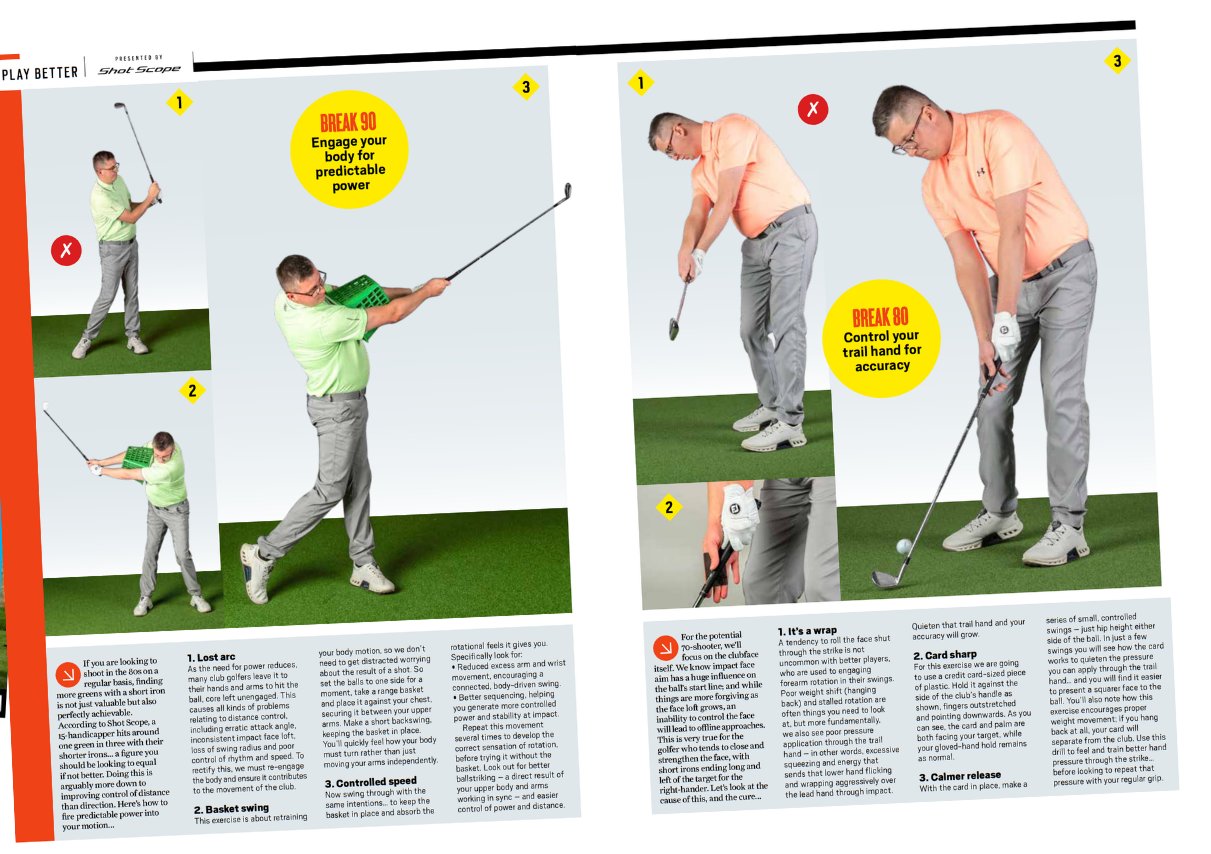
Engage your body for predictable power
If you are looking to shoot in the 80s on a regular basis, finding more greens with a short iron is not just valuable but also perfectly achievable. According to Shot Scope, a 15-handicapper hits around one green in three with their shorter irons… a figure you should be looking to equal if not better. Doing this is arguably more down to improving control of distance than direction. Here’s how to fire predictable power into your motion…
Lost arc
As the need for power reduces, many club golfers leave it to their hands and arms to hit the ball, core left unengaged. This causes all kinds of problems relating to distance control, including erratic attack angle, inconsistent impact face loft, loss of swing radius and poor control of rhythm and speed. To rectify this, we must re-engage the body and ensure it contributes to the movement of the club.
Basket swing
This exercise is about retraining your body motion, so we don’t need to get distracted worrying about the result of a shot. So set the balls to one side for a moment, take a range basket and place it against your chest, securing it between your upper arms. Make a short backswing, keeping the basket in place. You’ll quickly feel how your body must turn rather than just moving your arms independently.
Controlled speed
Now swing through with the same intentions… to keep the basket in place and absorb the rotational feels it gives you. Specifically look for:
• Reduced excess arm and wrist movement, encouraging a connected, body-driven swing.• Better sequencing, helping you generate more controlled power and stability at impact.
Repeat this movement several times to develop the correct sensation of rotation, before trying it without the basket. Look out for better ballstriking – a direct result of your upper body and arms working in sync – and easier control of power and distance.
Control your trail hand for accuracy
For the potential 70-shooter, we’ll focus on the clubface itself. We know impact face aim has a huge influence on the ball’s start line; and while things are more forgiving as the face loft grows, an inability to control the face will lead to offline approaches. This is very true for the golfer who tends to close and strengthen the face, with short irons ending long and left of the target for the right-hander. Let’s look at the cause of this, and the cure…
It’s a wrap
A tendency to roll the face shut through the strike is not uncommon with better players, who are used to engaging forearm rotation in their swings. Poor weight shift (hanging back) and stalled rotation are often things you need to look at, but more fundamentally, we also see poor pressure application through the trail hand – in other words, excessive squeezing and energy that sends that lower hand flicking and wrapping aggressively over the lead hand through impact. Quieten that trail hand and your accuracy will grow.
Card sharp
For this exercise we are going to use a credit card-sized piece of plastic. Hold it against the side of the club’s handle as shown, fingers outstretched and pointing downwards. As you can see, the card and palm are both facing your target, while your gloved-hand hold remains as normal.
Calmer release
With the card in place, make a series of small, controlled swings – just hip height either side of the ball. In just a few swings you will see how the card works to quieten the pressure you can apply through the trail hand… and you will find it easier to present a squarer face to the ball. You’ll also note how this exercise encourages proper weight movement; if you hang back at all, your card will separate from the club. Use this drill to feel and train better hand pressure through the strike… before looking to repeat that pressure with your regular grip.

Steve Thomas
Steve is a PGA Fellow Coach, named in Today’s Golfer’s Top 50 UK Golf Coaches every year since 2020, and writes a monthly instruction feature for the magazine. A PGA Professional since 2011, he has coached more than 15,000 golfers and coaches in person in Shropshire and online.