

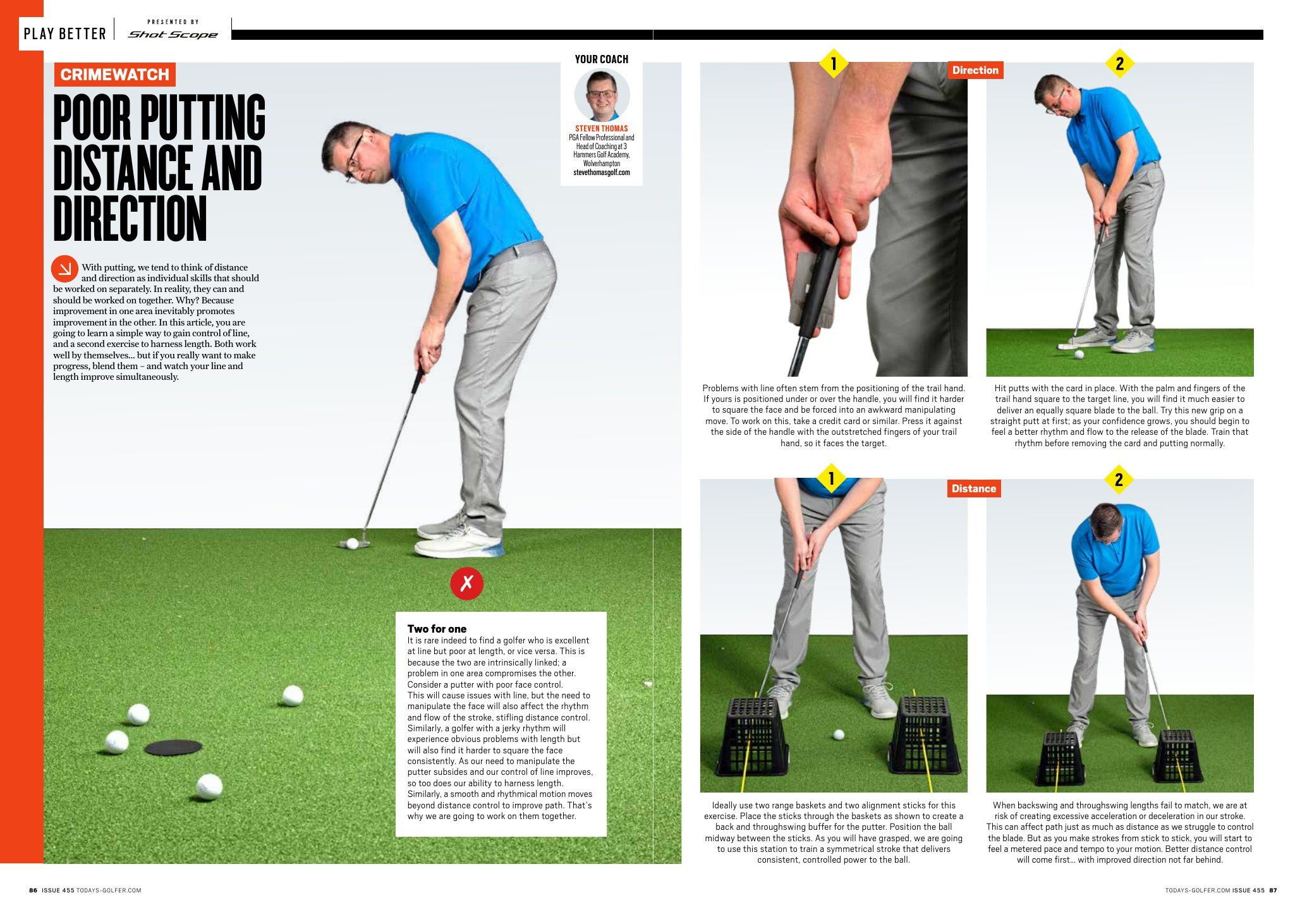
Poor putting distance and direction
With putting, we tend to think of distance and direction as individual skills that should be worked on separately. In reality, they can and should be worked on together. Why? Because improvement in one area inevitably promotes improvement in the other. In this article, you are going to learn a simple way to gain control of line, and a second exercise to harness length. Both work well by themselves… but if you really want to make progress, blend them – and watch your line and length improve simultaneously.
Two for one
It is rare indeed to find a golfer who is excellent at line but poor at length, or vice versa. This is because the two are intrinsically linked; a problem in one area compromises the other. Consider a putter with poor face control. This will cause issues with line, but the need to manipulate the face will also affect the rhythm and flow of the stroke, stifling distance control. Similarly, a golfer with a jerky rhythm will experience obvious problems with length but will also find it harder to square the face consistently. As our need to manipulate the putter subsides and our control of line improves, so too does our ability to harness length. Similarly, a smooth and rhythmical motion moves beyond distance control to improve path. That’s why we are going to work on them together.
New idea: role reversal
The first step to dealing with the sway, then, is conceptual. Instead of thinking we need to get behind the ball and help it up, we need to hold the concept of turning around a centre point – which is more in the middle of the stance – and squeezing down on the ball.
Sending the ball upward is not your job; it‘s the job of the clubface, which is lofted for that very purpose. Leave it to perform its role, and focus on yours.
Here are two exercises that will help…
Problems with line often stem from the positioning of the trail hand. If yours is positioned under or over the handle, you will find it harder to square the face and be forced into an awkward manipulating move. To work on this, take a credit card or similar. Press it against the side of the handle with the outstretched fingers of your trail hand, so it faces the target.
Hit putts with the card in place. With the palm and fingers of the trail hand square to the target line, you will find it much easier to deliver an equally square blade to the ball. Try this new grip on a straight putt at first; as your confidence grows, you should begin to feel a better rhythm and flow to the release of the blade. Train that rhythm before removing the card and putting normally.
Ideally use two range baskets and two alignment sticks for this exercise. Place the sticks through the baskets as shown to create a back and throughswing buffer for the putter. Position the ball midway between the sticks. As you will have grasped, we are going to use this station to train a symmetrical stroke that delivers consistent, controlled power to the ball.
When backswing and throughswing lengths fail to match, we are at risk of creating excessive acceleration or deceleration in our stroke. This can affect path just as much as distance as we struggle to control the blade. But as you make strokes from stick to stick, you will start to feel a metered pace and tempo to your motion. Better distance control will come first… with improved direction not far behind.

Steve Thomas
Steve is a PGA Fellow Coach, named in Today’s Golfer’s Top 50 UK Golf Coaches every year since 2020, and writes a monthly instruction feature for the magazine. A PGA Professional since 2011, he has coached more than 15,000 golfers and coaches in person in Shropshire and online.