
MY SYSTEM TO DEVELOP GOLFERS
How I coach
Start with how you score.
Find what's costing you shots.
Fix it with the smallest change that works.
PGA Fellow Coach · Today's Golfer Top 50 UK Coach · 15,000+ golfers coached
What I believe
There's more than one way to play great golf. My job isn't to sell you a method. It's to help you understand your own game well enough to own it.
We test it, not just trust it
It's a collaboration
Measure, don't guess
The system
Eight steps. The same loop every time.
New to the game or off scratch, in person or online — this is how we work.
01
Discover
How you actually score.
You get where your shots go.
02
Benchmark
Your numbers against your level.
You get what’s ahead, what’s behind.
03
Pinpoint
The area costing you most.
You get one priority, not ten.
04
Diagnose
What’s weak there, and why.
You get the cause, on camera and in numbers.
05
Predict
Test the options before changing anything.
You get one change, and the reason.
06
Prescribe
The lightest fix that works.
You get drills, Skills Games, a plan for the week.
07
Prove
Retest when the work is nearly done.
You get before and after, side by side.
08
Review
What worked. What’s next.
You get the next priority, set together.
Step 02 · Benchmark, in practice
What does a golfer at your level actually do?
Pick your handicap. Real-round averages — the first thing we look at together.
Handicap
A scratch golfer averages +2.0, with 0.3 doubles or worse a round.
Tee shots
285yds
driver, better strikes
Penalties off the tee 0.14 a round
Approach
59%
greens in regulation
Green hit from 100–150 yards 62%
Short game
54%
up and down inside 50 yards
From 25–50 yards 32%
Putting
76%
holed from 3–6 feet
Three-putts 3% of greens
A 5 handicap averages +8.0, with 1.4 doubles or worse a round.
Tee shots
261yds
driver, better strikes
Penalties off the tee 0.14 a round
Approach
41%
greens in regulation
Green hit from 100–150 yards 47%
Short game
47%
up and down inside 50 yards
From 25–50 yards 25%
Putting
67%
holed from 3–6 feet
Three-putts 6% of greens
A 10 handicap averages +13.0, with 2.9 doubles or worse a round.
Tee shots
259yds
driver, better strikes
Penalties off the tee 0.14 a round
Approach
32%
greens in regulation
Green hit from 100–150 yards 41%
Short game
39%
up and down inside 50 yards
From 25–50 yards 20%
Putting
65%
holed from 3–6 feet
Three-putts 7% of greens
A 15 handicap averages +18.4, with 4.7 doubles or worse a round.
Tee shots
236yds
driver, better strikes
Penalties off the tee 0.28 a round
Approach
21%
greens in regulation
Green hit from 100–150 yards 32%
Short game
34%
up and down inside 50 yards
From 25–50 yards 16%
Putting
59%
holed from 3–6 feet
Three-putts 11% of greens
A 20 handicap averages +23.2, with 6.7 doubles or worse a round.
Tee shots
225yds
driver, better strikes
Penalties off the tee 0.28 a round
Approach
14%
greens in regulation
Green hit from 100–150 yards 25%
Short game
31%
up and down inside 50 yards
From 25–50 yards 14%
Putting
55%
holed from 3–6 feet
Three-putts 13% of greens
A 25 handicap averages +29.9, with 9.2 doubles or worse a round.
Tee shots
204yds
driver, better strikes
Penalties off the tee 0.56 a round
Approach
9%
greens in regulation
Green hit from 100–150 yards 19%
Short game
25%
up and down inside 50 yards
From 25–50 yards 9%
Putting
48%
holed from 3–6 feet
Three-putts 13% of greens
Your numbers go next to these. Behind your level is where we start. Distances are measured against your own driver, not the average — and fairways hit isn’t shown because it barely moves from scratch (50%) to 25 (47%).
Source: Shot Scope 2025, averages from real rounds at each handicap.
Steps 05–06 · The fix, in practice
It isn't always a swing change.
Four kinds of work, all equal. The diagnosis decides.
Technique
How you move the club.
e.g. low point control for thin strikes
Skill
What you can repeat.
e.g. landing wedges in a 10-yard band
Practice
How you spend the hour.
e.g. random practice with a score
Strategy
The shot you choose.
e.g. aiming at the fat side of the green
Find it yourself→External based task→Internal based task / drills→Technical detail
Start at the lightest end. Go further only when needed.
Step 07 · Prove, in practice
Each area has a test. Each test has a number to beat.
Skills Games: twenty shots, scored out of 100, against your level. First session sets the start; we retest when the work is nearly done.
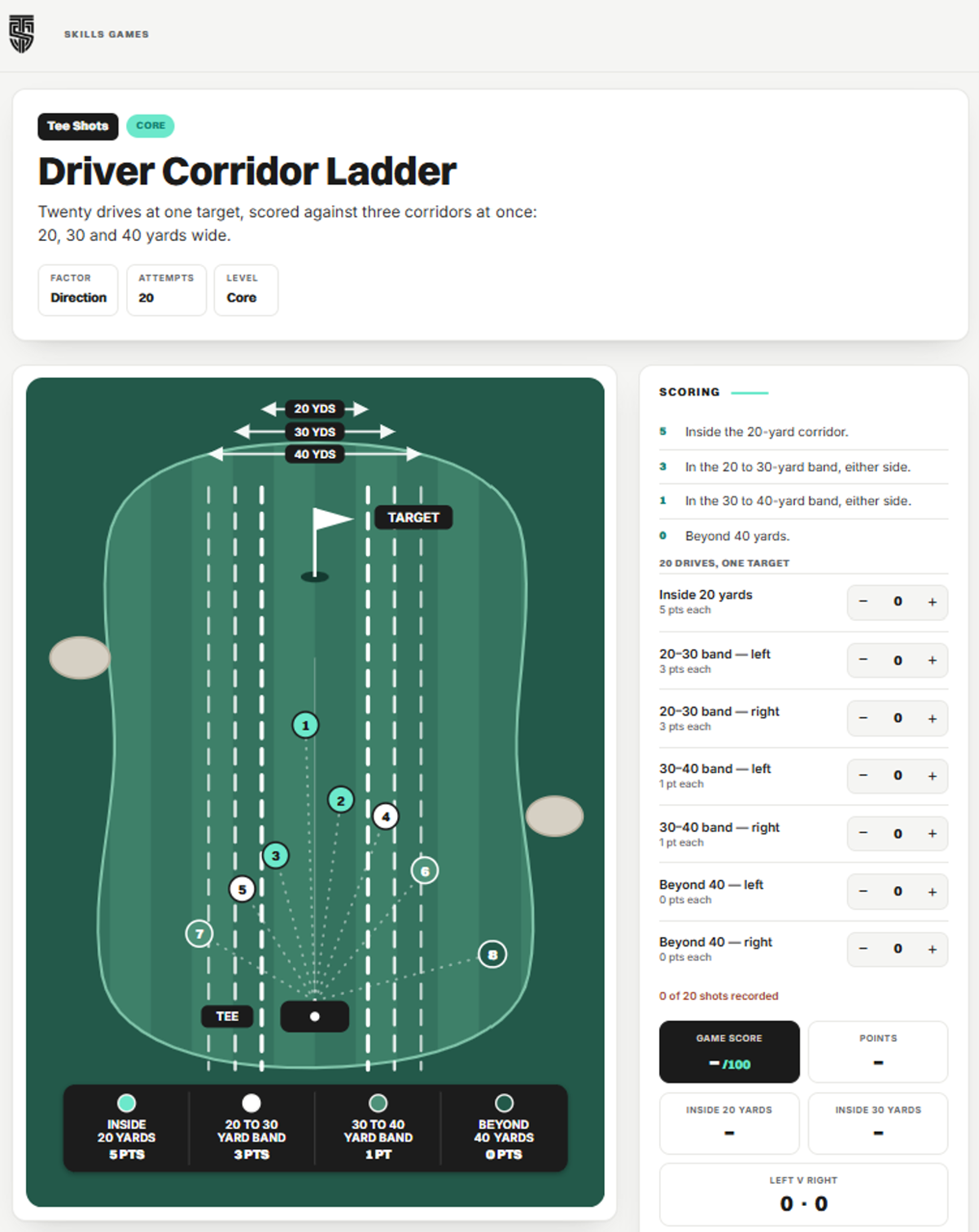
Driver Corridor Ladder
Tee shots · twenty drives, three corridors
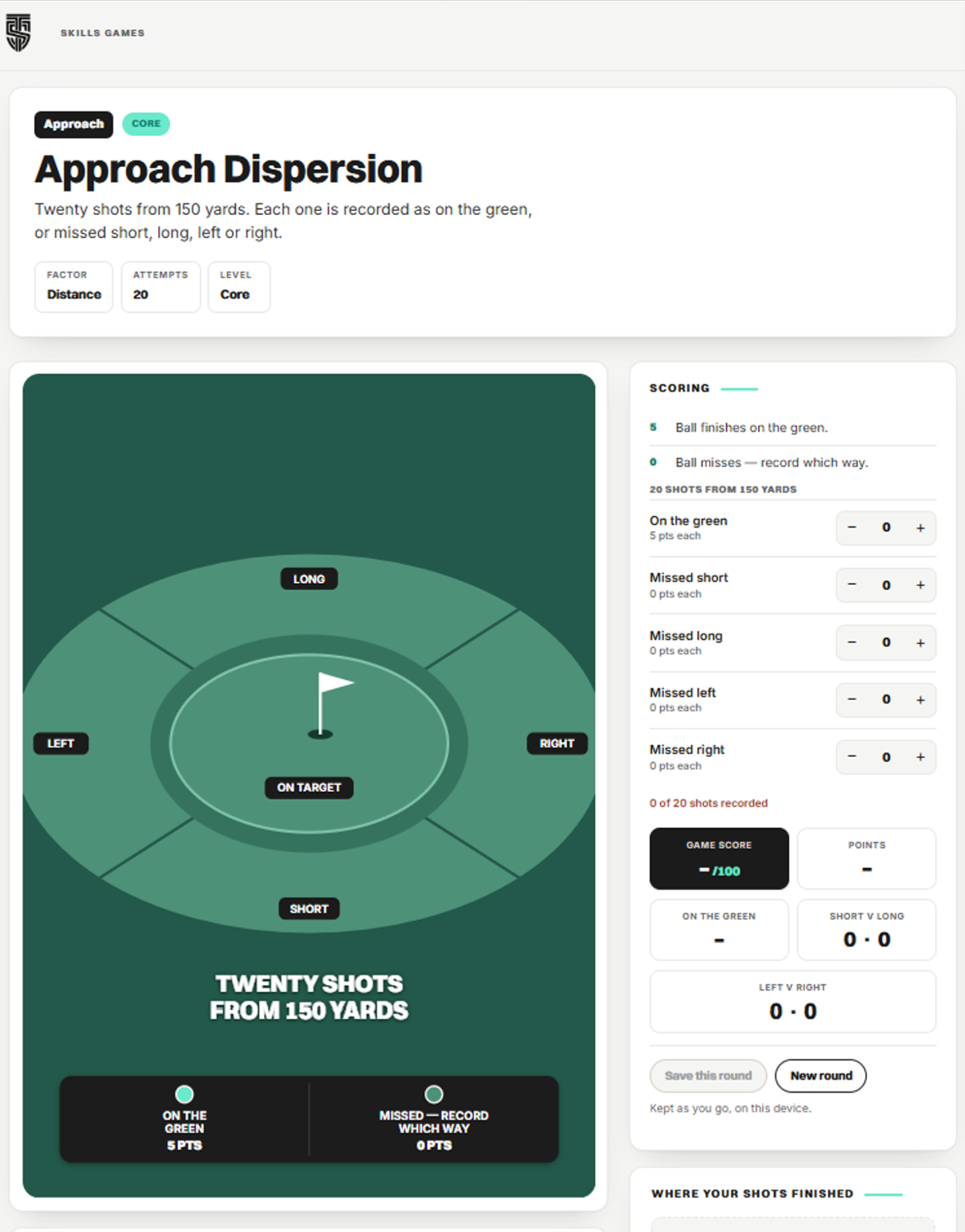
Approach Dispersion
Approach · twenty shots from 150 yards
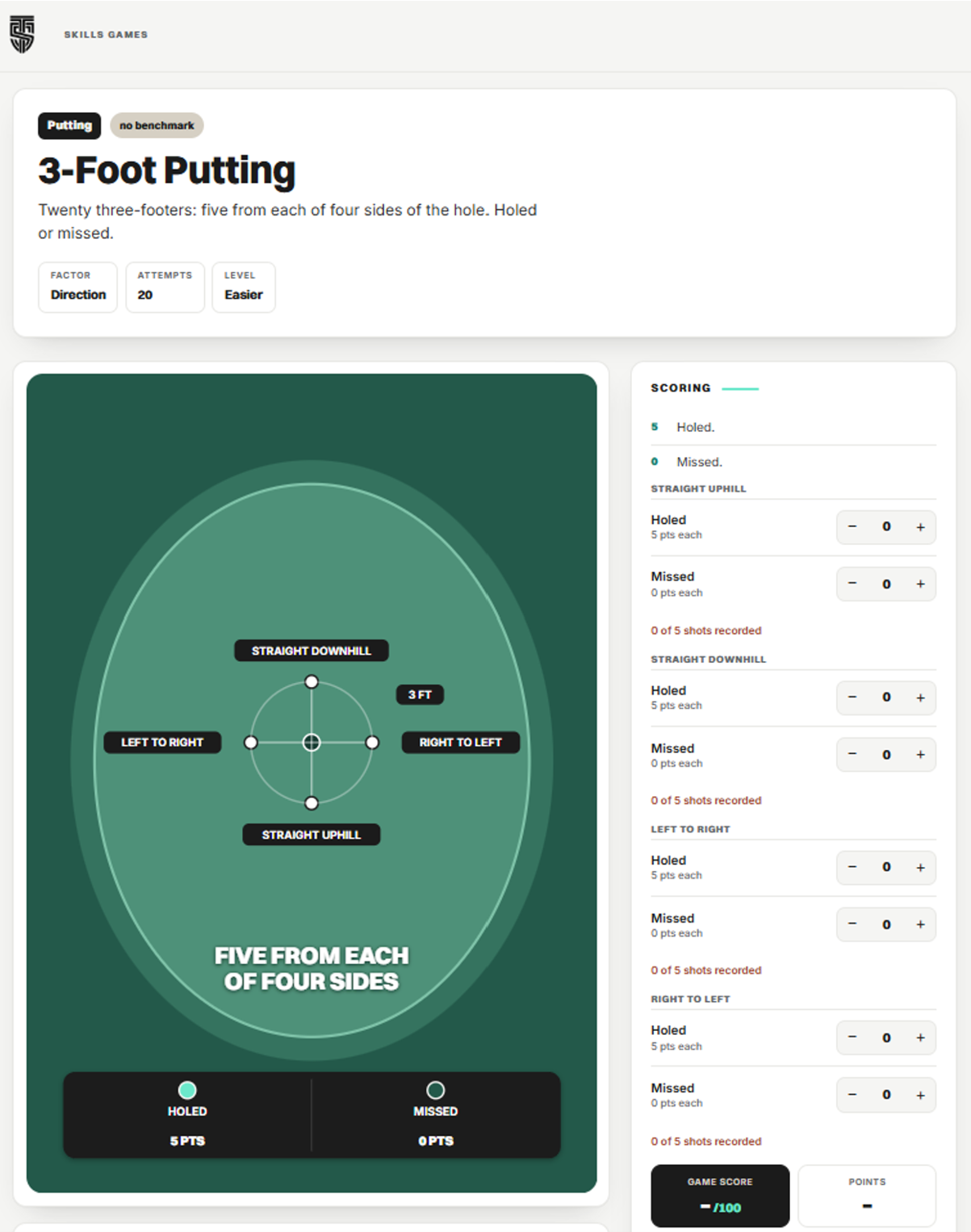
3-Foot Putting
Putting · twenty putts, four sides of the hole
What you can expect
You'll know it's working.
1
Ball flight and contact improve
2
Skills Games scores climb
3
Your on-course numbers move
4
Your scores follow
In that order, every time. How fast depends on the work you put in.
Your members area
Every student has one — in person, online or on the training week.
01
Your development plan
By area: on benchmark or not, what we’re working on, what to practise.
02
Skills Games
The full library, with your history for each one.
03
The Benchmark Book
Every number here and hundreds more, for every level.
04
Your stats
Record your rounds. See the patterns.
05
Your profile
Goals, history, how you play and practise.
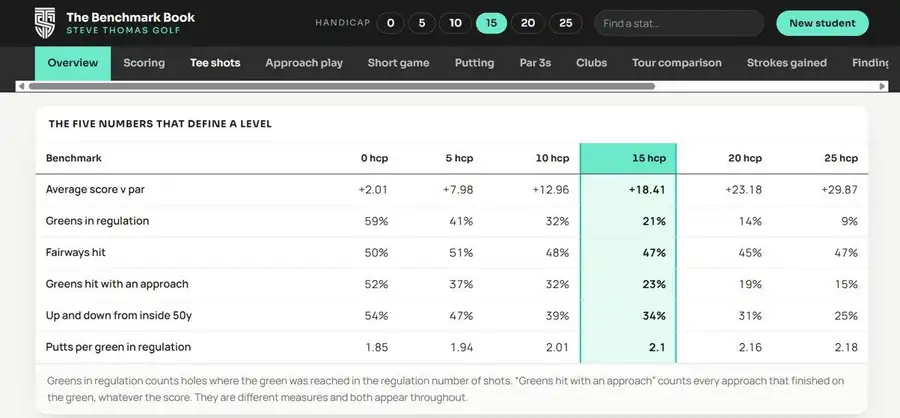
The Benchmark Book, in the members area.
Who it's for
The system is the same. Where it starts depends on you.
New to golf
Clean contact, ball in the air, how to practise.
→
Mid handicap
Cutting the doubles.
→
Low handicap
Scoring zones, wedge distance, strategy.
→
Elite players
Fine margins: tournament prep, stats against tour level, pressure-tested practice.
→
Older golfers
A movement screen first. Your swing, your body.
→
Junior
Skills and games, not positions.
→
Short on time
A plan for the hours you actually have.
→
Common doubts
Will this work for me?
I've had lessons before and got worse.
That shouldn’t happen. Ball flight and contact improve early. If they don’t, we change the approach — the numbers tell us.
I don't keep stats. Is this for me?
Yes. Five tallies over three rounds is all we need to start.
I'm a high handicapper. Is this too technical?
No. The numbers are for me. You get one priority and the work to do.
Does online work as well as in person?
Same system, same members area. Videos and numbers come to me through OnForm; every review comes back as two videos — what I see, how to fix it.
Your first step
Want to know what's costing you shots?
Most of my students stay with me 18 months or more. See their results →