
Golf Benchmarks by Handicap: Where Should Your Numbers Be?
“What should a 15 handicapper hit?” is a question golfers often ask, and the honest answer usually surprises them.
Most of us compare ourselves to tour players, or to our best day. The useful comparison is what golfers at your own level actually do. Here are the real numbers, and what to do with them.
In short
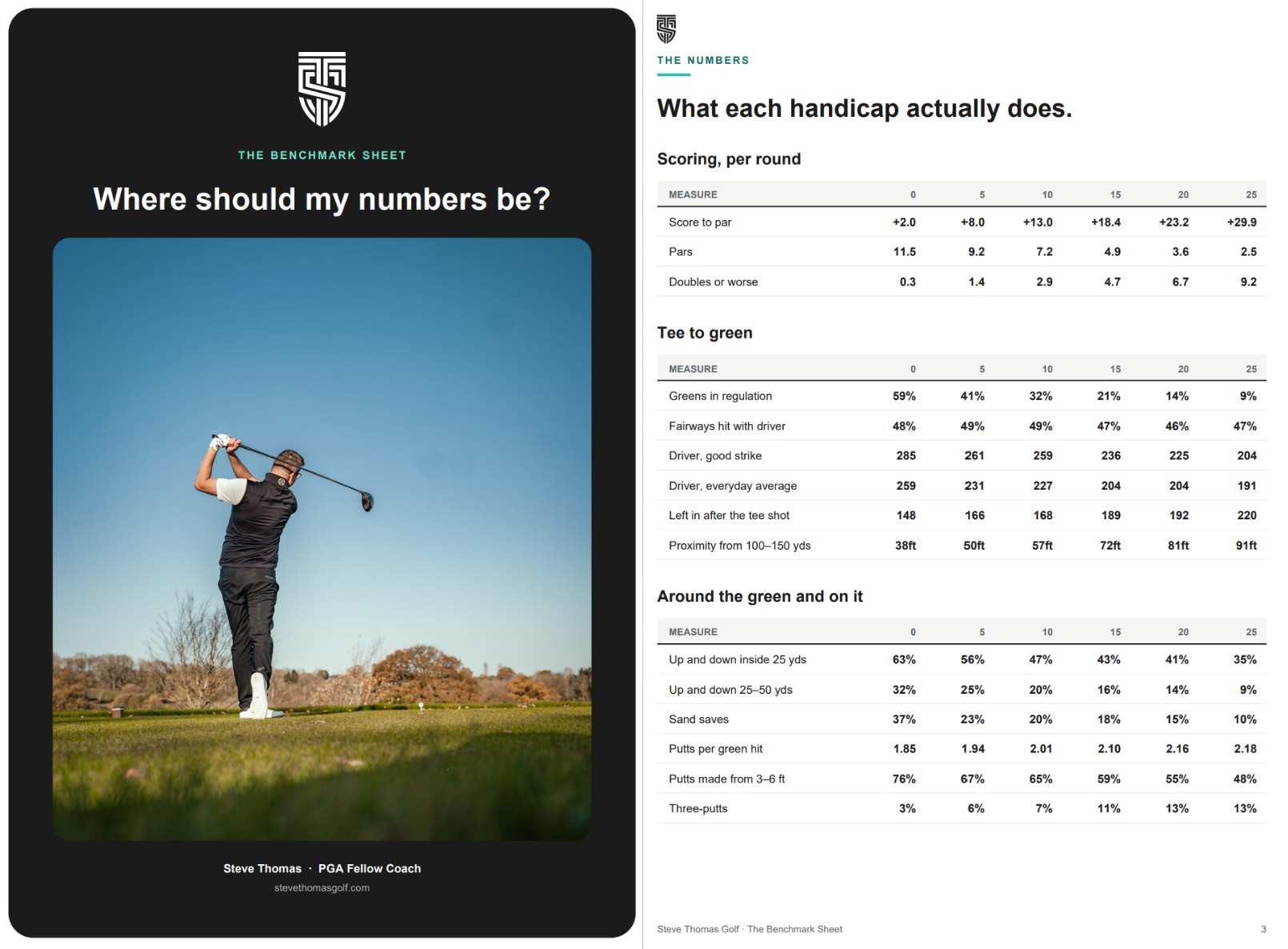
- A 15 handicapper hits about 21% of greens and gets up and down inside 25 yards 43% of the time.
- Fairways hit hardly change with handicap. Approach play and doubles do.
- Lower handicaps come from removing double bogeys, not adding birdies.
Where the numbers come from
These figures come from Shot Scope’s 2025 handicap data: tracked rounds from real amateur golfers, grouped by handicap. They are averages, not targets for your best day. Yardages describe the golfers in the sample, so if you hit it shorter or longer than average, scale them to your own driver.
Scoring by handicap
| Per round | 0 | 5 | 10 | 15 | 20 | 25 |
|---|---|---|---|---|---|---|
| Score to par | +2.0 | +8.0 | +13.0 | +18.4 | +23.2 | +29.9 |
| Pars | 11.5 | 9.2 | 7.2 | 4.9 | 3.6 | 2.5 |
| Doubles or worse | 0.3 | 1.4 | 2.9 | 4.7 | 6.7 | 9.2 |
Look at the doubles. A 20 handicapper makes almost seven a round. Turn half of them into bogeys and you are playing to around 17, without hitting a single better shot from the tee.
Tee to green
| Measure | 0 | 5 | 10 | 15 | 20 | 25 |
|---|---|---|---|---|---|---|
| Greens in regulation | 59% | 41% | 32% | 21% | 14% | 9% |
| Fairways hit with driver | 48% | 49% | 49% | 47% | 46% | 47% |
| Driver, everyday average (yds) | 259 | 231 | 227 | 204 | 204 | 191 |
| Proximity from 100–150 yds | 38ft | 50ft | 57ft | 72ft | 81ft | 91ft |
| Half your greens hit from (yds) | 166 | 121 | 96 | 74 | 60 | 57 |
The last row is the most useful number in the set: the distance from which golfers at each level hit half their greens. A 15 handicapper does it from about 74 yards. Most golfers expect it to be a lot further.
Around the green and on it
| Measure | 0 | 5 | 10 | 15 | 20 | 25 |
|---|---|---|---|---|---|---|
| Up and down inside 25 yds | 63% | 56% | 47% | 43% | 41% | 35% |
| Up and down 25–50 yds | 32% | 25% | 20% | 16% | 14% | 9% |
| Sand saves | 37% | 23% | 20% | 18% | 15% | 10% |
| Putts made from 3–6 ft | 76% | 67% | 65% | 59% | 55% | 48% |
| Three-putts | 3% | 6% | 7% | 11% | 13% | 13% |
Four things the numbers tell you
1. Fairways don’t separate golfers. Approach play does. A scratch golfer hits 48% of fairways with driver. A 25 handicapper hits 47%. What changes is how close the next shot finishes. Try this: for three rounds, stop counting fairways and count greens hit from inside 150 yards instead.
2. Almost every approach miss is short. From 150 yards, golfers at every level rarely miss long. Most miss short, because they club off their best strike, not their everyday one. Try this: when you are between clubs, take the longer one.
3. Lower scores come from fewer doubles. Birdies are close to zero from 15 handicap up. Doubles are not. Try this: write the number of doubles on your card after every round, and take your medicine back to the fairway when you are in trouble.
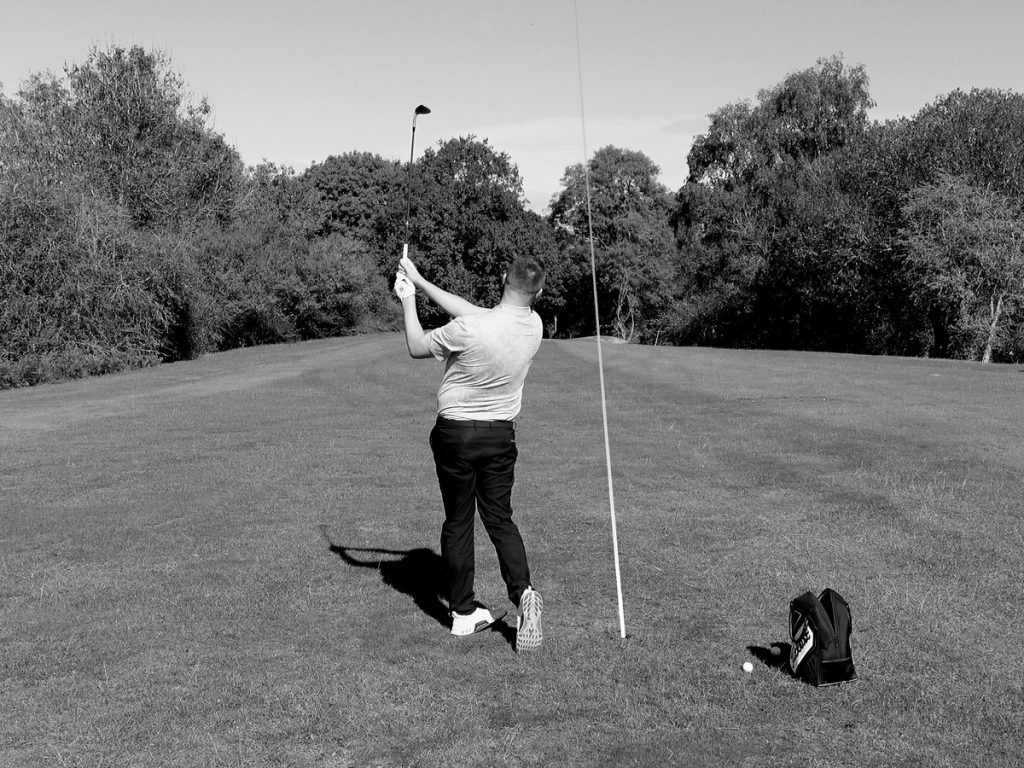
4. 25 to 50 yards is everyone’s weakest distance. At every level, golfers get up and down from 25–50 yards about half as often as from inside 25. It is the shot amateurs practise least.
DO THIS
Put down three targets at 30, 40 and 50 yards. Play five balls to each and count how many finish inside 15 feet. Write the number down and repeat it each week.
How to use these benchmarks
- Find your column. If you are a 12, read between the 10 and 15 columns.
- Track three rounds. Greens, up and downs, three-putts and doubles are enough to start.
- Find the biggest gap. The measure furthest below your column is costing you the most shots.
- Work on that first. One priority, measured, then retest.
That is exactly how I coach. In the STG Golf Coaching System, every golfer starts by finding where their shots are going, then we fix the cause and prove it with data.
Frequently asked questions
What percentage of greens should a 15 handicapper hit? About 21%, or roughly four greens a round.
How many fairways should I hit for my handicap? Fairways hit with driver stay between 46% and 49% from scratch to 25 handicap, so fairways alone don’t explain the difference.
How many 3 to 6 foot putts should a 20 handicapper make? About 55%. A scratch golfer makes about 76%.
What is the fastest way to lower my handicap? For most golfers it is cutting double bogeys. A 20 handicapper averages almost seven a round.
Do these benchmarks apply to every golfer? Percentages work for any golfer. Yardages describe the golfers in the sample, so scale them to your own driver distance.
Want help closing the gap?
Book a free 15-minute Online Coaching Introduction Call. We’ll look at where your numbers sit and what to work on first. If you live in Shropshire, you can book a lesson instead.
Free: the STG Benchmark Sheet
Where should your numbers be?
See the benchmarks for every handicap from scratch to 25, then use the tally card on your next three rounds to find out what's really costing you shots.
Get the free sheet
Written by Steve Thomas
Steve Thomas is a PGA Fellow Coach and has been a PGA Professional since 2011.
He has been named in Today’s Golfer’s Top 50 UK Golf Coaches every year since 2020, writes a monthly feature for the magazine, and has coached more than 15,000 golfers.
He coaches online and in person at Shrewsbury School Golf Studio.
Last updated: October 2026