
Pure hybrids
At this time of year, the one club in your bag you really need firing is your hybrid. It is of course a year-round club, but in winter its value doubles thanks to its unique design. The shallow head means a low centre of gravity, promoting a soaring flight ideal for carry distance and holding distant, soft greens. Meanwhile, its curved and slender head slides against that snaggy, soggy turf and wet grass, giving it huge performance and versatility advantages over the angular iron.
But while the hybrid is one of golf’s more forgiving clubs, its longer shaft and smaller head ensure consistent ballstriking remains a challenge. So let’s look at three skill-oriented avenues for better hybrid play, starting as ever with the golfer looking to crack that magical 100 barrier…
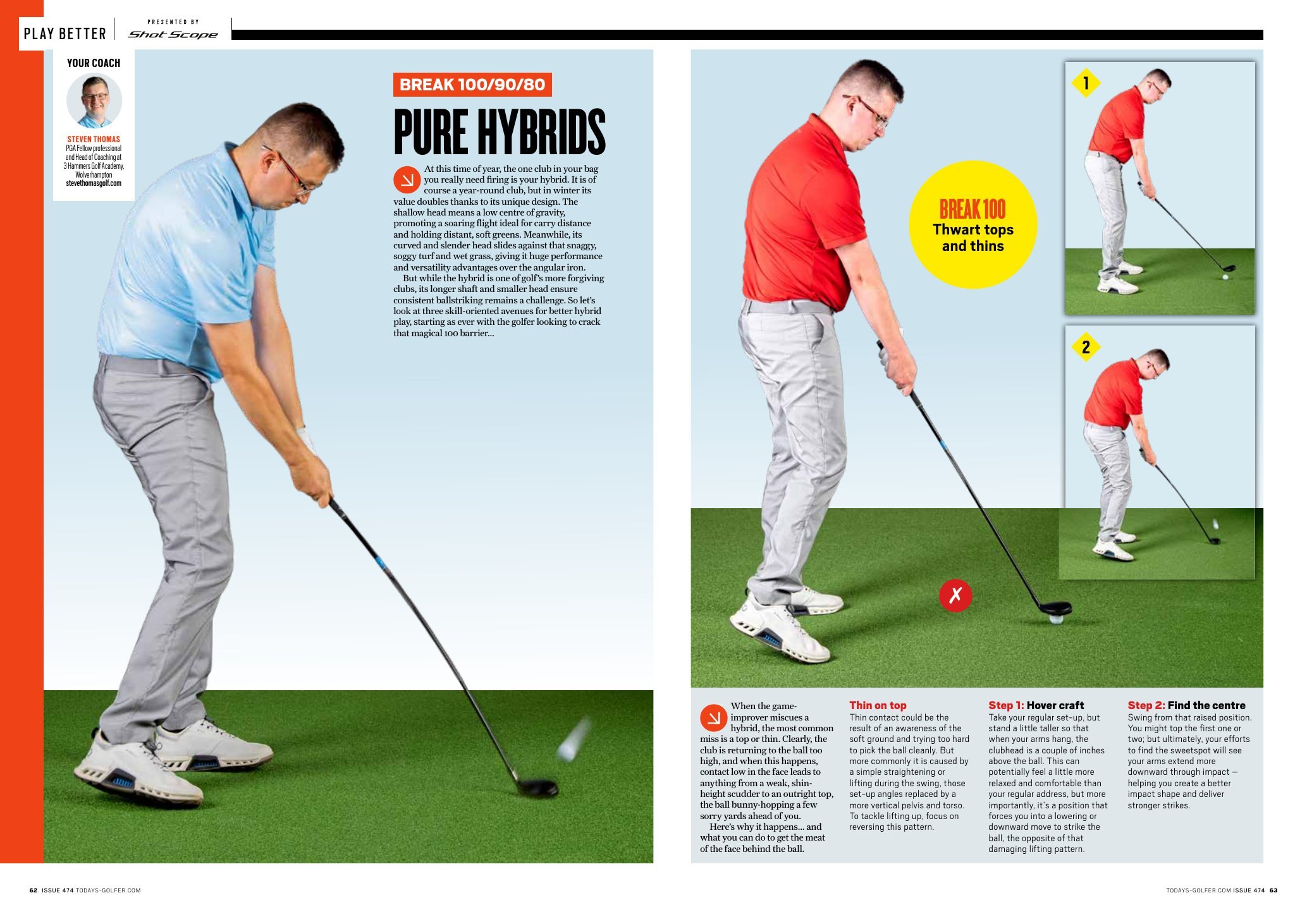
Thwart tops and thins
When the game-improver miscues a hybrid, the most common miss is a top or thin. Clearly, the club is returning to the ball too high, and when this happens, contact low in the face leads to anything from a weak, shin-height scudder to an outright top, the ball bunny-hopping a few sorry yards ahead of you. Here’s why it happens… and what you can do to get the meat of the face behind the ball.
Thin on top
Thin contact could be the result of an awareness of the soft ground and trying too hard to pick the ball cleanly. But more commonly it is caused by a simple straightening or lifting during the swing, those set-up angles replaced by a more vertical pelvis and torso. To tackle lifting up, focus on reversing this pattern.
Hover craft
Take your regular set-up, but stand a little taller so that when your arms hang, the clubhead is a couple of inches above the ball. This can potentially feel a little more relaxed and comfortable than your regular address, but more importantly, it’s a position that forces you into a lowering or downward move to strike the ball, the opposite of that damaging lifting pattern.
Find the centre
Swing from that raised position. You might top the first one or two; but ultimately, your efforts to find the sweetspot will see your arms extend more downward through impact – helping you create a better impact shape and deliver stronger strikes.
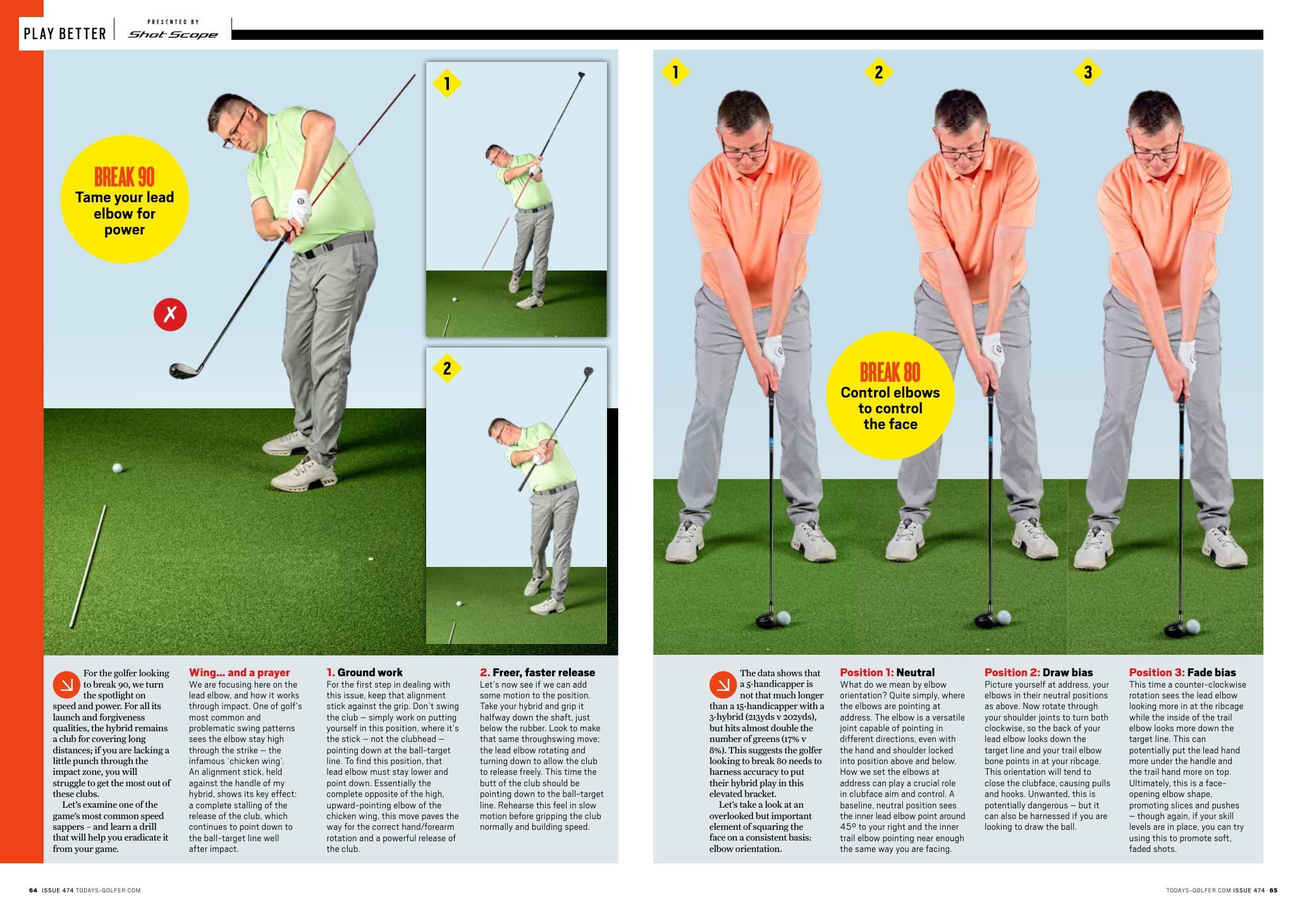
Tame your lead elbow for power
For the golfer looking to break 90, we turn the spotlight on speed and power. For all its launch and forgiveness qualities, the hybrid remains a club for covering long distances; if you are lacking a little punch through the impact zone, you will struggle to get the most out of these clubs. Let’s examine one of the game’s most common speed sappers – and learn a drill that will help you eradicate it from your game.
Wing… and a prayer
We are focusing here on the lead elbow, and how it works through impact. One of golf’s most common and problematic swing patterns sees the elbow stay high through the strike – the infamous ‘chicken wing’. An alignment stick, held against the handle of my hybrid, shows its key effect: a complete stalling of the release of the club, which continues to point down to the ball-target line well after impact.
Ground work
For the first step in dealing with this issue, keep that alignment stick against the grip. Don’t swing the club – simply work on putting yourself in this position, where it’s the stick – not the clubhead – pointing down at the ball-target line. To find this position, that lead elbow must stay lower and point down. Essentially the complete opposite of the high, upward-pointing elbow of the chicken wing, this move paves the way for the correct hand/forearm rotation and a powerful release of the club.
Freer, faster release
Let’s now see if we can add some motion to the position. Take your hybrid and grip it halfway down the shaft, just below the rubber. Look to make that same throughswing move; the lead elbow rotating and turning down to allow the club to release freely. This time the butt of the club should be pointing down to the ball-target line. Rehearse this feel in slow motion before gripping the club normally and building speed.
Control elbows to control the face
The data shows that a 5-handicapper is not that much longer than a 15-handicapper with a 3-hybrid (213yds v 202yds), but hits almost double the number of greens (17% v 8%). This suggests the golfer looking to break 80 needs to harness accuracy to put their hybrid play in this elevated bracket. Let’s take a look at an overlooked but important element of squaring the face on a consistent basis: elbow orientation.
Neutral
What do we mean by elbow orientation? Quite simply, where the elbows are pointing at address. The elbow is a versatile joint capable of pointing in different directions, even with the hand and shoulder locked into position above and below. How we set the elbows at address can play a crucial role in clubface aim and control. A baseline, neutral position sees the inner lead elbow point around 45° to your right and the inner trail elbow pointing near enough the same way you are facing.
Draw bias
Picture yourself at address, your elbows in their neutral positions as above. Now rotate through your shoulder joints to turn both clockwise, so the back of your lead elbow looks down the target line and your trail elbow bone points in at your ribcage. This orientation will tend to close the clubface, causing pulls and hooks. Unwanted, this is potentially dangerous – but it can also be harnessed if you are looking to draw the ball.
Fade bias
This time a counter-clockwise rotation sees the lead elbow looking more in at the ribcage while the inside of the trail elbow looks more down the target line. This can potentially put the lead hand more under the handle and the trail hand more on top. Ultimately, this is a face-opening elbow shape, promoting slices and pushes – though again, if your skill levels are in place, you can try using this to promote soft, faded shots.

Steve Thomas
Steve is a PGA Fellow Coach, named in Today’s Golfer’s Top 50 UK Golf Coaches every year since 2020, and writes a monthly instruction feature for the magazine. A PGA Professional since 2011, he has coached more than 15,000 golfers and coaches in person in Shropshire and online.