
Missing short putts
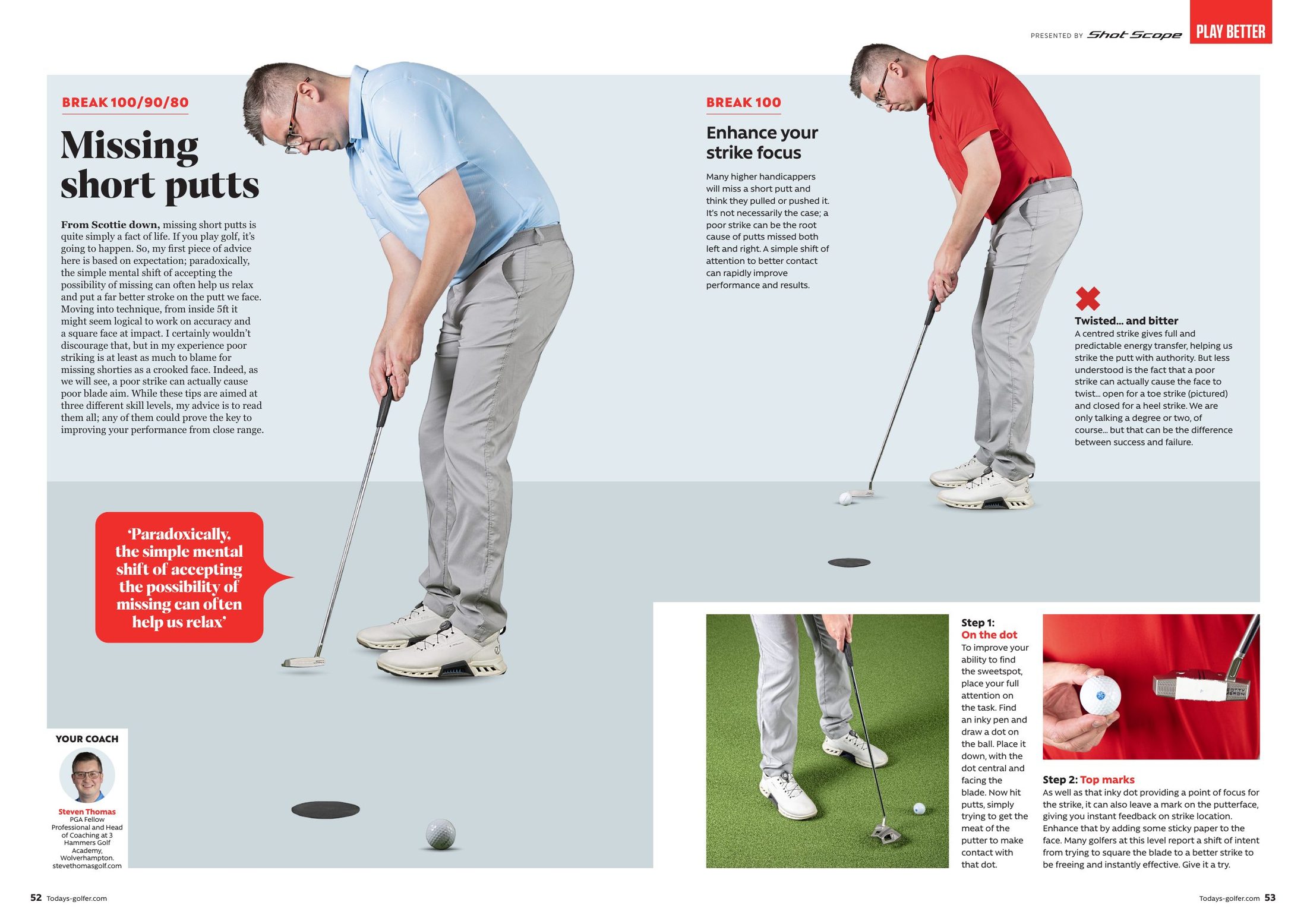
From Scottie down, missing short putts is quite simply a fact of life. If you play golf, it’s going to happen. So, my first piece of advice here is based on expectation; paradoxically, the simple mental shift of accepting the possibility of missing can often help us relax and put a far better stroke on the putt we face. Moving into technique, from inside 5ft it might seem logical to work on accuracy and a square face at impact. I certainly wouldn’t discourage that, but in my experience poor striking is at least as much to blame for missing shorties as a crooked face. Indeed, as we will see, a poor strike can actually cause poor blade aim. While these tips are aimed at three different skill levels, my advice is to read them all; any of them could prove the key to improving your performance from close range.
Enhance your strike focus
Many higher handicappers will miss a short putt and think they pulled or pushed it. It’s not necessarily the case; a poor strike can be the root cause of putts missed both left and right. A simple shift of attention to better contact can rapidly improve performance and results.
On the dot
To improve your ability to find the sweetspot, place your full attention on the task. Find an inky pen and draw a dot on the ball. Place it down, with the dot central and facing the blade. Now hit putts, simply trying to get the meat of the putter to make contact with that dot.
Top marks
As well as that inky dot providing a point of focus for the strike, it can also leave a mark on the putterface, giving you instant feedback on strike location. Enhance that by adding some sticky paper to the face. Many golfers at this level report a shift of intent from trying to square the blade to a better strike to be freeing and instantly effective. Give it a try.
Stabilise your stroke
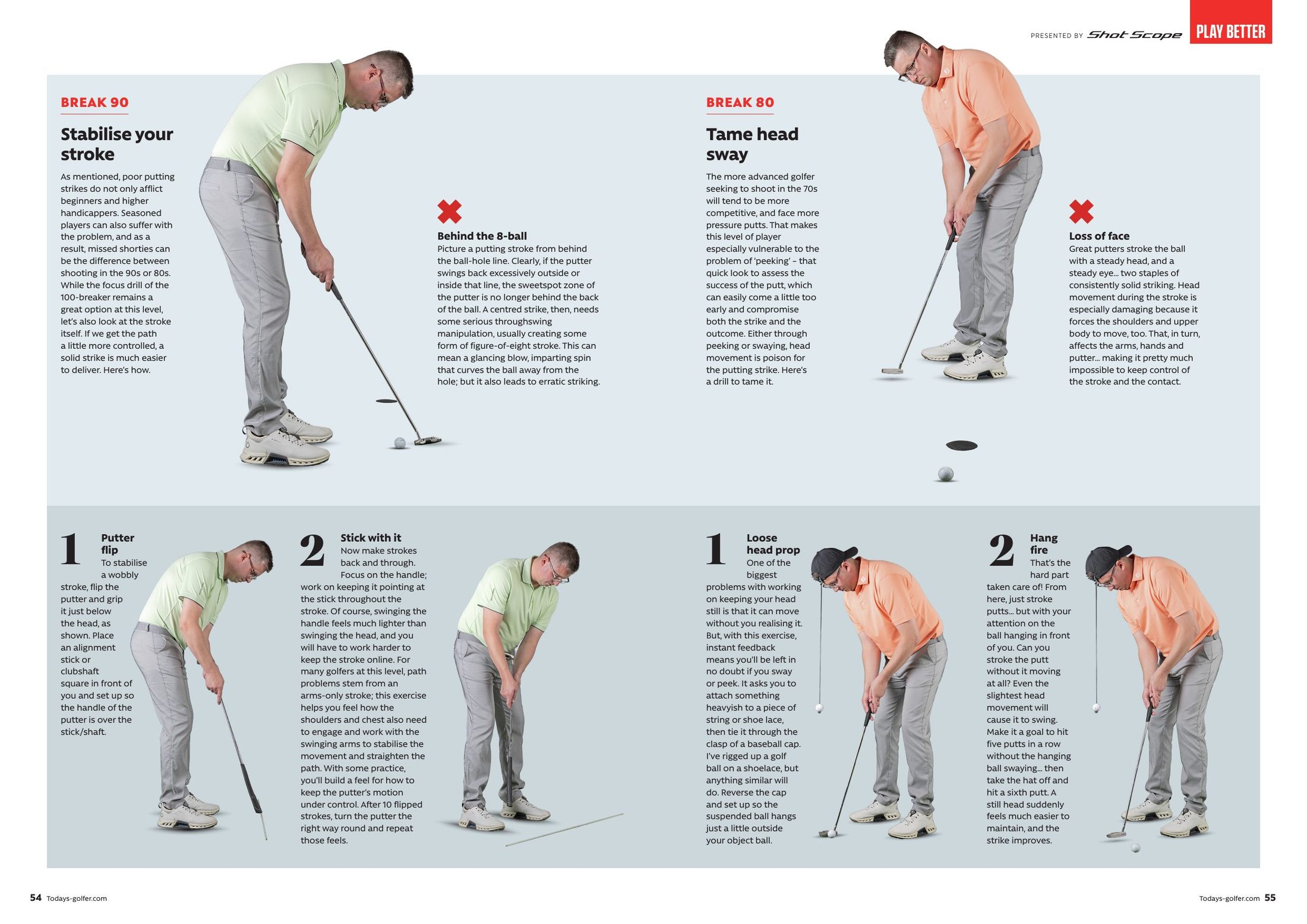
As mentioned, poor putting strikes do not only afflict beginners and higher handicappers. Seasoned players can also suffer with the problem, and as a result, missed shorties can be the difference between shooting in the 90s or 80s. While the focus drill of the 100-breaker remains a great option at this level, let’s also look at the stroke itself. If we get the path a little more controlled, a solid strike is much easier to deliver. Here’s how.
Putter flip
To stabilise a wobbly stroke, flip the putter and grip it just below the head, as shown. Place an alignment stick or clubshaft square in front of you and set up so the handle of the putter is over the stick/shaft.
Stick with it
Now make strokes back and through. Focus on the handle; work on keeping it pointing at the stick throughout the stroke. Of course, swinging the handle feels much lighter than swinging the head, and you will have to work harder to keep the stroke online. For many golfers at this level, path problems stem from an arms-only stroke; this exercise helps you feel how the shoulders and chest also need to engage and work with the swinging arms to stabilise the movement and straighten the path. With some practice, you’ll build a feel for how to keep the putter’s motion under control. After 10 flipped strokes, turn the putter the right way round and repeat those feels.
Tame head sway
The more advanced golfer seeking to shoot in the 70s will tend to be more competitive, and face more pressure putts. That makes this level of player especially vulnerable to the problem of ‘peeking’ – that quick look to assess the success of the putt, which can easily come a little too early and compromise both the strike and the outcome. Either through peeking or swaying, head movement is poison for the putting strike. Here’s a drill to tame it.
Loose head prop
One of the biggest problems with working on keeping your head still is that it can move without you realising it. But, with this exercise, instant feedback means you’ll be left in no doubt if you sway or peek. It asks you to attach something heavyish to a piece of string or shoe lace, then tie it through the clasp of a baseball cap. I’ve rigged up a golf ball on a shoelace, but anything similar will do. Reverse the cap and set up so the suspended ball hangs just a little outside your object ball.
Hang fire
That’s the hard part taken care of! From here, just stroke putts… but with your attention on the ball hanging in front of you. Can you stroke the putt without it moving at all? Even the slightest head movement will cause it to swing. Make it a goal to hit five putts in a row without the hanging ball swaying… then take the hat off and hit a sixth putt. A still head suddenly feels much easier to maintain, and the strike improves.
Twisted… and bitter
A centred strike gives full and predictable energy transfer, helping us strike the putt with authority. But less understood is the fact that a poor strike can actually cause the face to twist… open for a toe strike (pictured) and closed for a heel strike. We are only talking a degree or two, of course… but that can be the difference between success and failure.
Behind the 8-ball
Picture a putting stroke from behind the ball-hole line. Clearly, if the putter swings back excessively outside or inside that line, the sweetspot zone of the putter is no longer behind the back of the ball. A centred strike, then, needs some serious throughswing manipulation, usually creating some form of figure-of-eight stroke. This can mean a glancing blow, imparting spin that curves the ball away from the hole; but it also leads to erratic striking.
Loss of face
Great putters stroke the ball with a steady head, and a steady eye… two staples of consistently solid striking. Head movement during the stroke is especially damaging because it forces the shoulders and upper body to move, too. That, in turn, affects the arms, hands and putter… making it pretty much impossible to keep control of the stroke and the contact.

Steve Thomas
Steve is a PGA Fellow Coach, named in Today’s Golfer’s Top 50 UK Golf Coaches every year since 2020, and writes a monthly instruction feature for the magazine. A PGA Professional since 2011, he has coached more than 15,000 golfers and coaches in person in Shropshire and online.