
Powerful irons
Whatever your skill level, strengthening your iron shots is a genuinely valuable goal. Performance tracking has identified hitting the green as a key component of your score; and while weak, high shots invariably fall offline and usually short of their mark, powerful, penetrating shots burrow through crosswinds, holding their line and leaving you pin-high. Strike location, attack angle and swing sequencing all play their role in adding strength and quality to your ball-striking, and we will address all three through these skill-relevant exercises. Start with the one that applies to you but if you put all three into action, your iron play can’t help but benefit.
Get forward
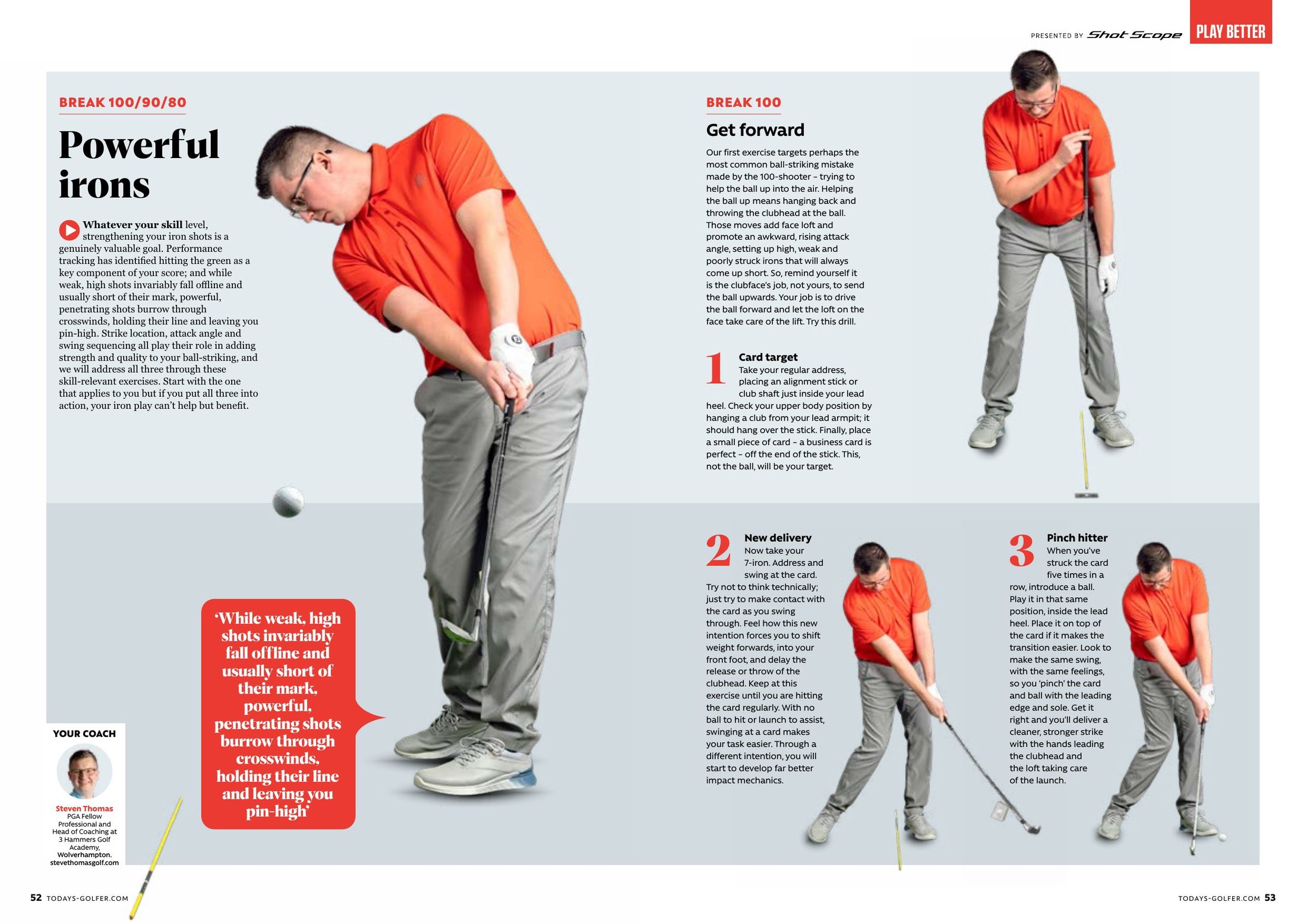
Our first exercise targets perhaps the most common ball-striking mistake made by the 100-shooter – trying to help the ball up into the air. Helping the ball up means hanging back and throwing the clubhead at the ball. Those moves add face loft and promote an awkward, rising attack angle, setting up high, weak and poorly struck irons that will always come up short. So, remind yourself it is the clubface’s job, not yours, to send the ball upwards. Your job is to drive the ball forward and let the loft on the face take care of the lift. Try this drill.
Card target
Take your regular address, placing an alignment stick or club shaft just inside your lead heel. Check your upper body position by hanging a club from your lead armpit; it should hang over the stick. Finally, place a small piece of card – a business card is perfect – off the end of the stick. This, not the ball, will be your target.
New delivery
Now take your 7-iron. Address and swing at the card. Try not to think technically; just try to make contact with the card as you swing through. Feel how this new intention forces you to shift weight forwards, into your front foot, and delay the release or throw of the clubhead. Keep at this exercise until you are hitting the card regularly. With no ball to hit or launch to assist, swinging at a card makes your task easier. Through a different intention, you will start to develop far better impact mechanics.
Pinch hitter
When you’ve struck the card five times in a row, introduce a ball. Play it in that same position, inside the lead heel. Place it on top of the card if it makes the transition easier. Look to make the same swing, with the same feelings, so you ‘pinch’ the card and ball with the leading edge and sole. Get it right and you’ll deliver a cleaner, stronger strike with the hands leading the clubhead and the loft taking care of the launch.
Build a tighter coil
The aspiring 80-shooter can absolutely benefit from the Break 100 exercise we’ve just learned, but with a little more ability in your locker, you can also build on that by training the mechanics of your backswing. The drills you will learn here are designed to help you achieve a strong, squeezing strike. We achieve that through controlling the low point of the swing’s arc, which falls opposite the lead chest. To hit punchy and powerful irons we need impact to take place just before the club reaches its lowest point, ensuring a subtle downward strike. The enemy here is falling behind the ball.
Chock bar
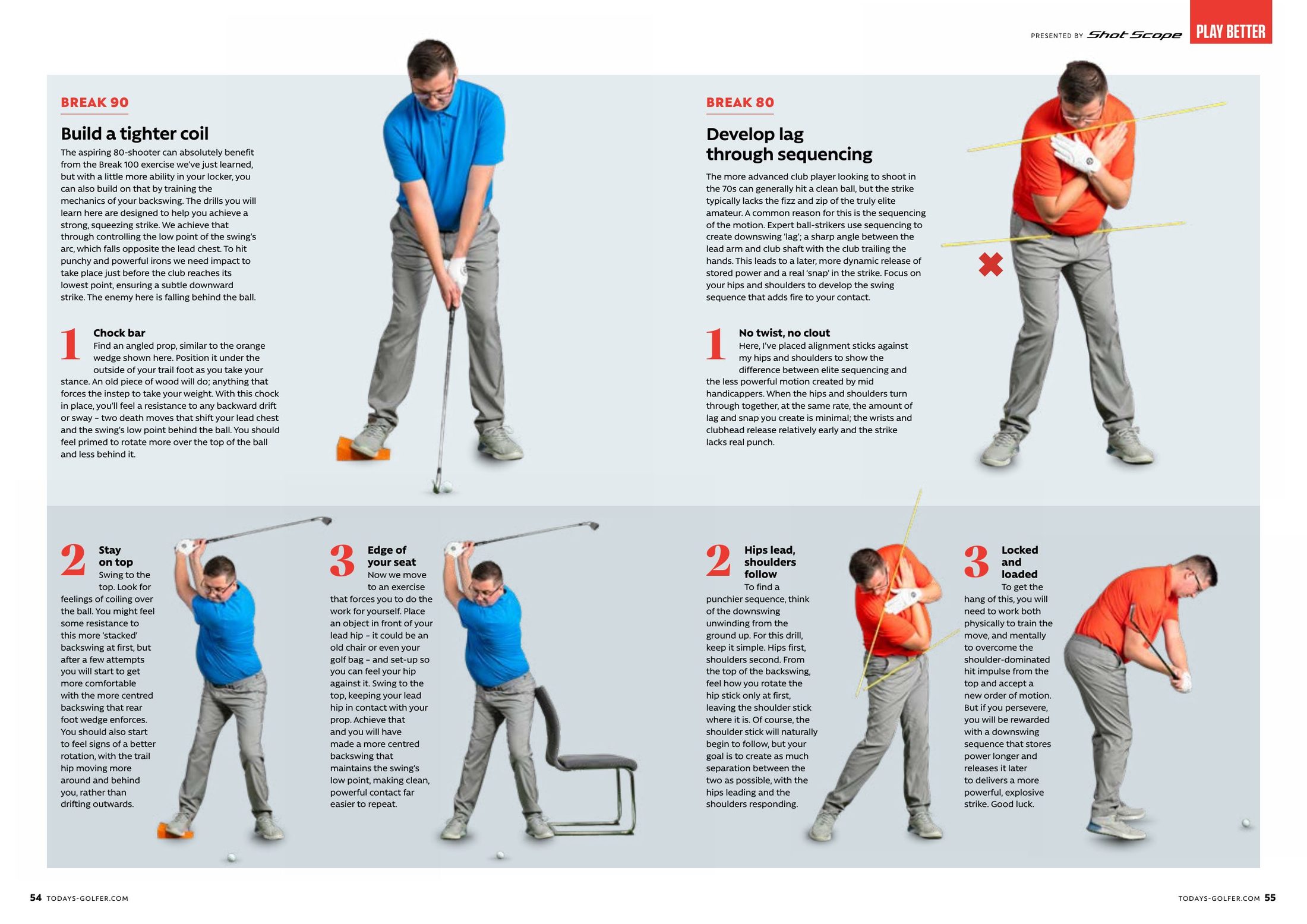
Find an angled prop, similar to the orange wedge shown here. Position it under the outside of your trail foot as you take your stance. An old piece of wood will do; anything that forces the instep to take your weight. With this chock in place, you’ll feel a resistance to any backward drift or sway – two death moves that shift your lead chest and the swing’s low point behind the ball. You should feel primed to rotate more over the top of the ball and less behind it.
Stay on top
Swing to the top. Look for feelings of coiling over the ball. You might feel some resistance to this more ‘stacked’ backswing at first, but after a few attempts you will start to get more comfortable with the more centred backswing that rear foot wedge enforces. You should also start to feel signs of a better rotation, with the trail hip moving more around and behind you, rather than drifting outwards.
Edge of your seat
Now we move to an exercise that forces you to do the work for yourself. Place an object in front of your lead hip – it could be an old chair or even your golf bag – and set-up so you can feel your hip against it. Swing to the top, keeping your lead hip in contact with your prop. Achieve that and you will have made a more centred backswing that maintains the swing’s low point, making clean, powerful contact far easier to repeat.
Develop lag through sequencing
The more advanced club player looking to shoot in the 70s can generally hit a clean ball, but the strike typically lacks the fizz and zip of the truly elite amateur. A common reason for this is the sequencing of the motion. Expert ball-strikers use sequencing to create downswing ‘lag’; a sharp angle between the lead arm and club shaft with the club trailing the hands. This leads to a later, more dynamic release of stored power and a real ‘snap’ in the strike. Focus on your hips and shoulders to develop the swing sequence that adds fire to your contact.
No twist, no clout
Here, I’ve placed alignment sticks against my hips and shoulders to show the difference between elite sequencing and the less powerful motion created by mid handicappers. When the hips and shoulders turn through together, at the same rate, the amount of lag and snap you create is minimal; the wrists and clubhead release relatively early and the strike lacks real punch.
Hips lead, shoulders follow
To find a punchier sequence, think of the downswing unwinding from the ground up. For this drill, keep it simple. Hips first, shoulders second. From the top of the backswing, feel how you rotate the hip stick only at first, leaving the shoulder stick where it is. Of course, the shoulder stick will naturally begin to follow, but your goal is to create as much separation between the two as possible, with the hips leading and the shoulders responding.
Locked and loaded
To get the hang of this, you will need to work both physically to train the move, and mentally to overcome the shoulder-dominated hit impulse from the top and accept a new order of motion. But if you persevere, you will be rewarded with a downswing sequence that stores power longer and releases it later to delivers a more powerful, explosive strike. Good luck.

Steve Thomas
Steve is a PGA Fellow Coach, named in Today’s Golfer’s Top 50 UK Golf Coaches every year since 2020, and writes a monthly instruction feature for the magazine. A PGA Professional since 2011, he has coached more than 15,000 golfers and coaches in person in Shropshire and online.