
Putting inconsistency
Every one of you will be able to recall a day on the greens when everything seemed to drop and putting felt effortless. But those wonderful moments can be frustratingly few and far between. More often, we face a sense of bewilderment as we are heavy-handed one minute and tentative the next. Of course, green reading plays its part, but we can also blame general inconsistencies in the stroke for this confusing picture. Blade aim, putter speed and strike point can all vary and when they do, the sense of befuddlement saps our belief. Aimed at different skill levels, these three approaches will guide you towards more dependable movement, more predictable results and a growing sense of confidence.
Target rhythm
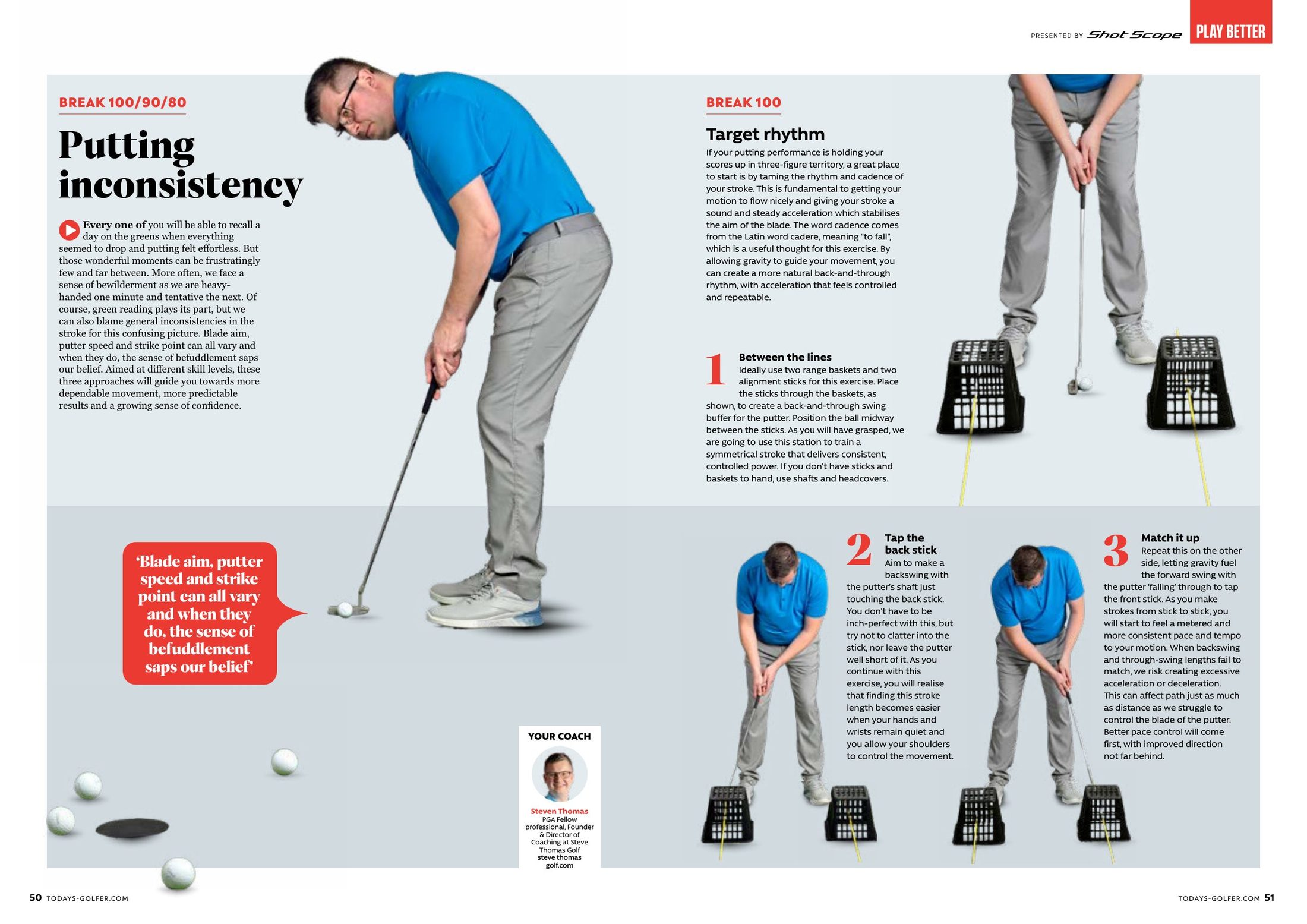
If your putting performance is holding your scores up in three-figure territory, a great place to start is by taming the rhythm and cadence of your stroke. This is fundamental to getting your motion to flow nicely and giving your stroke a sound and steady acceleration which stabilises the aim of the blade. The word cadence comes from the Latin word cadere, meaning “to fall”, which is a useful thought for this exercise. By allowing gravity to guide your movement, you can create a more natural back-and-through rhythm, with acceleration that feels controlled and repeatable.
Between the lines
Ideally use two range baskets and two alignment sticks for this exercise. Place the sticks through the baskets, as shown, to create a back-and-through swing buffer for the putter. Position the ball midway between the sticks. As you will have grasped, we are going to use this station to train a symmetrical stroke that delivers consistent, controlled power. If you don’t have sticks and baskets to hand, use shafts and headcovers.
Tap the back stick
Aim to make a backswing with the putter’s shaft just touching the back stick. You don’t have to be inch-perfect with this, but try not to clatter into the stick, nor leave the putter well short of it. As you continue with this exercise, you will realise that finding this stroke length becomes easier when your hands and wrists remain quiet and you allow your shoulders to control the movement.
Match it up
Repeat this on the other side, letting gravity fuel the forward swing with the putter ‘falling’ through to tap the front stick. As you make strokes from stick to stick, you will start to feel a metered and more consistent pace and tempo to your motion. When backswing and through-swing lengths fail to match, we risk creating excessive acceleration or deceleration. This can affect path just as much as distance as we struggle to control the blade of the putter. Better pace control will come first, with improved direction not far behind.
Train stability
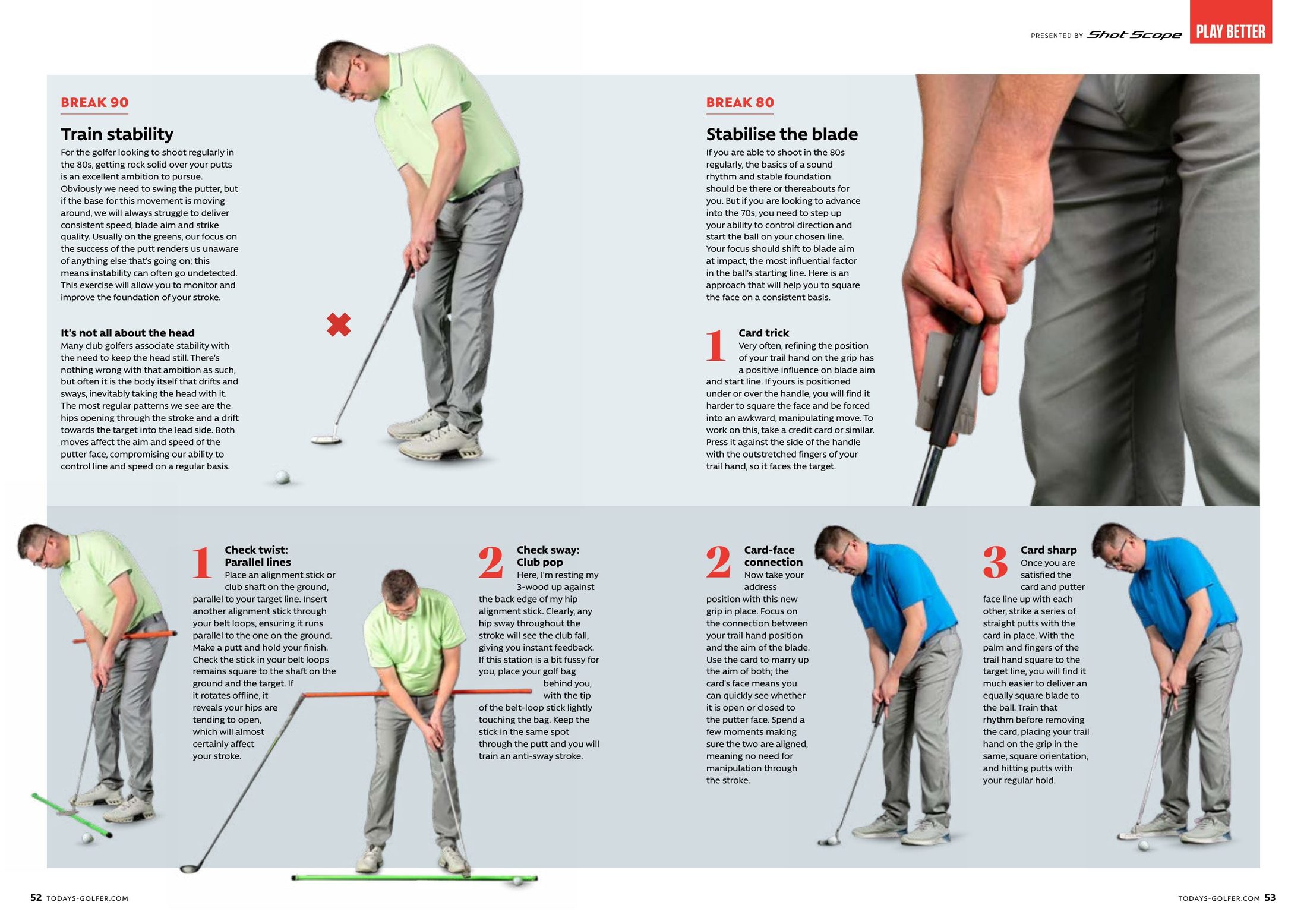
For the golfer looking to shoot regularly in the 80s, getting rock solid over your putts is an excellent ambition to pursue. Obviously we need to swing the putter, but if the base for this movement is moving around, we will always struggle to deliver consistent speed, blade aim and strike quality. Usually on the greens, our focus on the success of the putt renders us unaware of anything else that’s going on; this means instability can often go undetected. This exercise will allow you to monitor and improve the foundation of your stroke.
It’s not all about the head
Many club golfers associate stability with the need to keep the head still. There’s nothing wrong with that ambition as such, but often it is the body itself that drifts and sways, inevitably taking the head with it. The most regular patterns we see are the hips opening through the stroke and a drift towards the target into the lead side. Both moves affect the aim and speed of the putter face, compromising our ability to control line and speed on a regular basis.
Check twist: Parallel lines
Place an alignment stick or club shaft on the ground, parallel to your target line. Insert another alignment stick through your belt loops, ensuring it runs parallel to the one on the ground. Make a putt and hold your finish. Check the stick in your belt loops remains square to the shaft on the ground and the target. If it rotates offline, it reveals your hips are tending to open, which will almost certainly affect your stroke.
Check sway: Club pop
Here, I’m resting my 3-wood up against the back edge of my hip alignment stick. Clearly, any hip sway throughout the stroke will see the club fall, giving you instant feedback. If this station is a bit fussy for you, place your golf bag behind you, with the tip of the belt-loop stick lightly touching the bag. Keep the stick in the same spot through the putt and you will train an anti-sway stroke.
Stabilise the blade
If you are able to shoot in the 80s regularly, the basics of a sound rhythm and stable foundation should be there or thereabouts for you. But if you are looking to advance into the 70s, you need to step up your ability to control direction and start the ball on your chosen line. Your focus should shift to blade aim at impact, the most influential factor in the ball’s starting line. Here is an approach that will help you to square the face on a consistent basis.
Card trick
Very often, refining the position of your trail hand on the grip has a positive influence on blade aim and start line. If yours is positioned under or over the handle, you will find it harder to square the face and be forced into an awkward, manipulating move. To work on this, take a credit card or similar. Press it against the side of the handle with the outstretched fingers of your trail hand, so it faces the target.
Card-face connection
Now take your address position with this new grip in place. Focus on the connection between your trail hand position and the aim of the blade. Use the card to marry up the aim of both; the card’s face means you can quickly see whether it is open or closed to the putter face. Spend a few moments making sure the two are aligned, meaning no need for manipulation through the stroke.
Card sharp
Once you are satisfied the card and putter face line up with each other, strike a series of straight putts with the card in place. With the palm and fingers of the trail hand square to the target line, you will find it much easier to deliver an equally square blade to the ball. Train that rhythm before removing the card, placing your trail hand on the grip in the same, square orientation, and hitting putts with your regular hold.

Steve Thomas
Steve is a PGA Fellow Coach, named in Today’s Golfer’s Top 50 UK Golf Coaches every year since 2020, and writes a monthly instruction feature for the magazine. A PGA Professional since 2011, he has coached more than 15,000 golfers and coaches in person in Shropshire and online.