
Wake up your core!
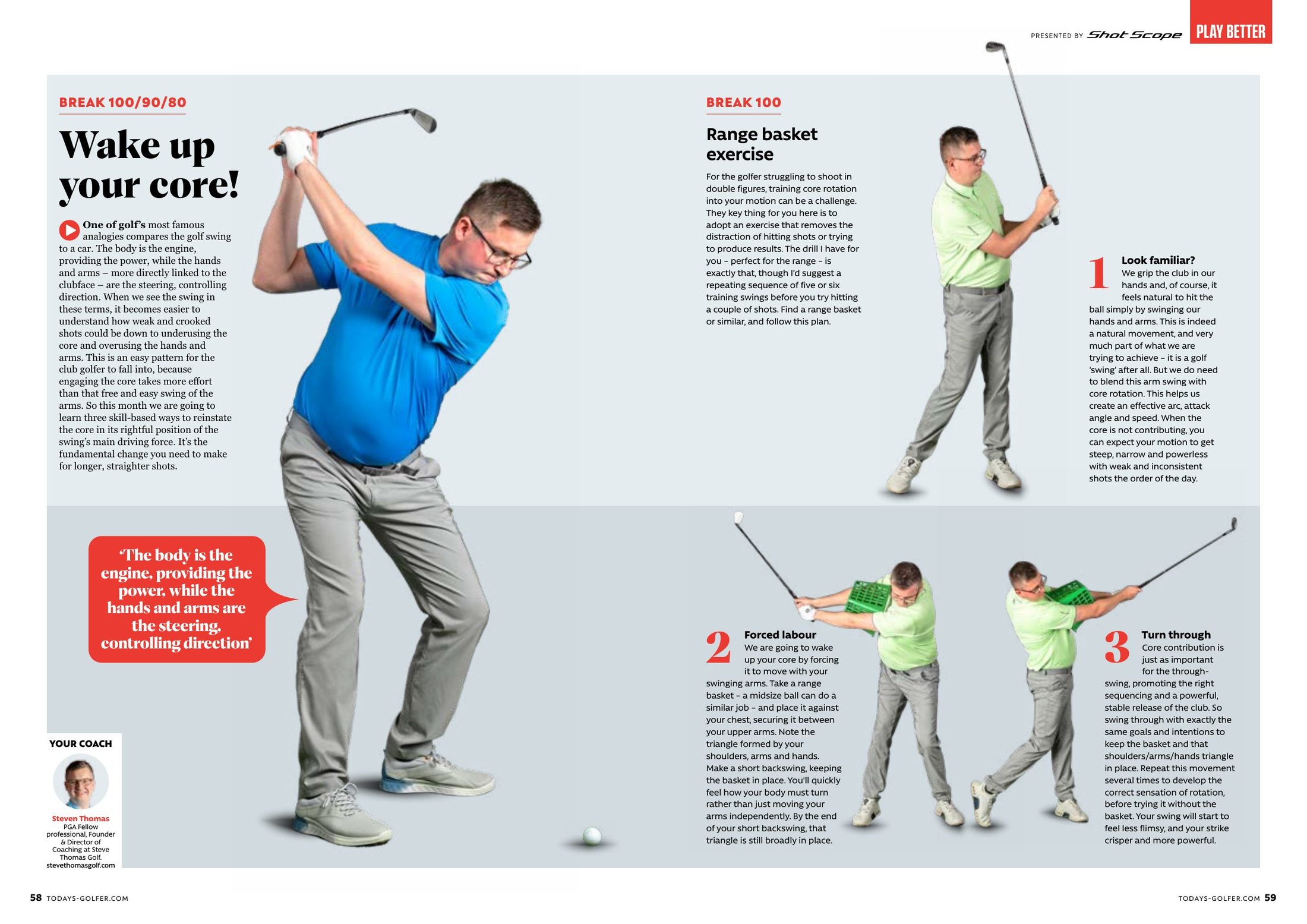
One of golf’s most famous analogies compares the golf swing to a car. The body is the engine, providing the power, while the hands and arms – more directly linked to the clubface – are the steering, controlling direction. When we see the swing in these terms, it becomes easier to understand how weak and crooked shots could be down to underusing the core and overusing the hands and arms. This is an easy pattern for the club golfer to fall into, because engaging the core takes more effort than that free and easy swing of the arms. So this month we are going to learn three skill-based ways to reinstate the core in its rightful position of the swing’s main driving force. It’s the fundamental change you need to make for longer, straighter shots.
Range basket exercise
For the golfer struggling to shoot in double figures, training core rotation into your motion can be a challenge. They key thing for you here is to adopt an exercise that removes the distraction of hitting shots or trying to produce results. The drill I have for you – perfect for the range – is exactly that, though I’d suggest a repeating sequence of five or six training swings before you try hitting a couple of shots. Find a range basket or similar, and follow this plan.
Look familiar?
We grip the club in our hands and, of course, it feels natural to hit the ball simply by swinging our hands and arms. This is indeed a natural movement, and very much part of what we are trying to achieve – it is a golf ‘swing’ after all. But we do need to blend this arm swing with core rotation. This helps us create an effective arc, attack angle and speed. When the core is not contributing, you can expect your motion to get steep, narrow and powerless with weak and inconsistent shots the order of the day.
Forced labour
We are going to wake up your core by forcing it to move with your swinging arms. Take a range basket – a midsize ball can do a similar job – and place it against your chest, securing it between your upper arms. Note the triangle formed by your shoulders, arms and hands. Make a short backswing, keeping the basket in place. You’ll quickly feel how your body must turn rather than just moving your arms independently. By the end of your short backswing, that triangle is still broadly in place.
Turn through
Core contribution is just as important for the through-swing, promoting the right sequencing and a powerful, stable release of the club. So swing through with exactly the same goals and intentions to keep the basket and that shoulders/arms/hands triangle in place. Repeat this movement several times to develop the correct sensation of rotation, before trying it without the basket. Your swing will start to feel less flimsy, and your strike crisper and more powerful.
Teach your torso to turn
The basket exercise for the 100-breaker works by forcing the core into action, potentially giving the golfer a new experience of how the swing is driven. The more experienced player is likely to know the need for the core to rotate back and through, and has possibly worked on it in the past. Here the issue is more likely be falling into bad habits, giving in to a grumpy torso that feels chronically disinclined to rotate. This simple exercise is an excellent way to remind your torso of its responsibilities, and to loosen up the muscles that allow it to make its back and through rotation.
Three lines
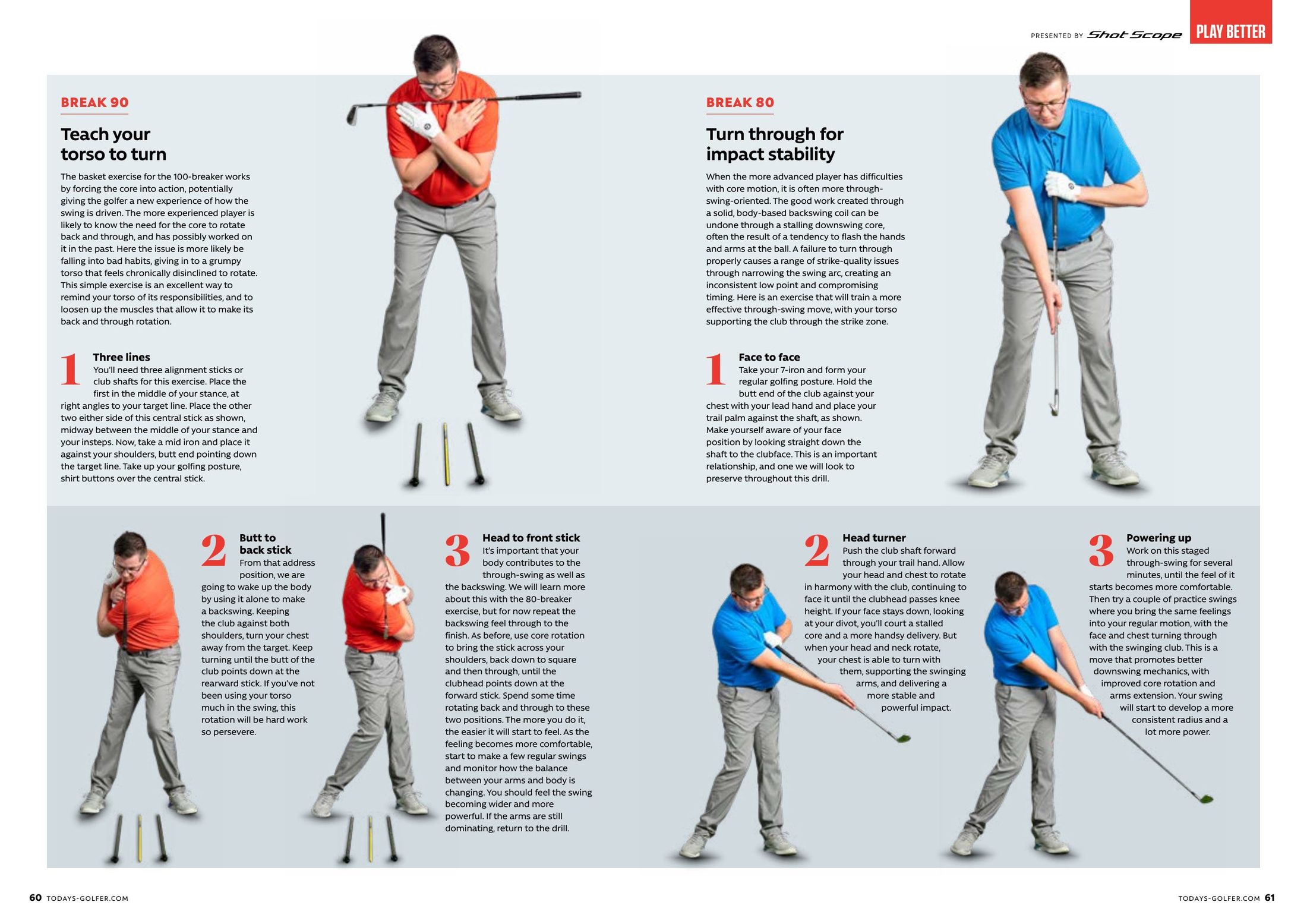
You’ll need three alignment sticks or club shafts for this exercise. Place the first in the middle of your stance, at right angles to your target line. Place the other two either side of this central stick as shown, midway between the middle of your stance and your insteps. Now, take a mid iron and place it against your shoulders, butt end pointing down the target line. Take up your golfing posture, shirt buttons over the central stick.
Butt to back stick
From that address position, we are going to wake up the body by using it alone to make a backswing. Keeping the club against both shoulders, turn your chest away from the target. Keep turning until the butt of the club points down at the rearward stick. If you’ve not been using your torso much in the swing, this rotation will be hard work so persevere.
Head to front stick
It’s important that your body contributes to the through-swing as well as the backswing. We will learn more about this with the 80-breaker exercise, but for now repeat the backswing feel through to the finish. As before, use core rotation to bring the stick across your shoulders, back down to square and then through, until the clubhead points down at the forward stick. Spend some time rotating back and through to these two positions. The more you do it, the easier it will start to feel. As the feeling becomes more comfortable, start to make a few regular swings and monitor how the balance between your arms and body is changing. You should feel the swing becoming wider and more powerful. If the arms are still dominating, return to the drill.
Turn through for impact stability
When the more advanced player has difficulties with core motion, it is often more through-swing-oriented. The good work created through a solid, body-based backswing coil can be undone through a stalling downswing core, often the result of a tendency to flash the hands and arms at the ball. A failure to turn through properly causes a range of strike-quality issues through narrowing the swing arc, creating an inconsistent low point and compromising timing. Here is an exercise that will train a more effective through-swing move, with your torso supporting the club through the strike zone.
Face to face
Take your 7-iron and form your regular golfing posture. Hold the butt end of the club against your chest with your lead hand and place your trail palm against the shaft, as shown. Make yourself aware of your face position by looking straight down the shaft to the clubface. This is an important relationship, and one we will look to preserve throughout this drill.
Head turner
Push the club shaft forward through your trail hand. Allow your head and chest to rotate in harmony with the club, continuing to face it until the clubhead passes knee height. If your face stays down, looking at your divot, you’ll court a stalled core and a more handsy delivery. But when your head and neck rotate, your chest is able to turn with them, supporting the swinging arms, and delivering a more stable and powerful impact.
Powering up
Work on this staged through-swing for several minutes, until the feel of it starts becomes more comfortable. Then try a couple of practice swings where you bring the same feelings into your regular motion, with the face and chest turning through with the swinging club. This is a move that promotes better downswing mechanics, with improved core rotation and arms extension. Your swing will start to develop a more consistent radius and a lot more power.

Steve Thomas
Steve is a PGA Fellow Coach, named in Today’s Golfer’s Top 50 UK Golf Coaches every year since 2020, and writes a monthly instruction feature for the magazine. A PGA Professional since 2011, he has coached more than 15,000 golfers and coaches in person in Shropshire and online.