What to Expect From Online Golf Coaching: My Process, Step by Step
This is what happens when someone starts online coaching with me, from the first call to the first re-test.
My coaching starts with how you play on the course, not how your swing looks on video. A swing can look textbook and still cost you shots. Your scores show me where to look first. Then we work on whatever is holding you back: technique, skill, how you practise or how you play the course.
In short
A free 15-minute call, then a full assessment of your game against handicap benchmarks.
A plan for the one area costing you the most shots, with two-video swing reviews.
Support all month, then a re-test to prove the change before moving on.
Step 1: A free 15-minute introduction call
We talk about your golf:
your handicap
what frustrates you
what you’ve tried before
what you want from the next six months
It’s also your chance to see whether we’d work well together. If online coaching isn’t right for you, I’ll say so.
Step 2: Your player profile
Once you join, you fill in your player profile in my members area: your golfing history, how often you play and practise, your goals, and anything that affects how you move.
I know your game before I’ve seen a single swing.
Step 3: A full assessment of your game
I build the picture from three sources:
On the course. You record your rounds with the stats sheet in the members area: tee shots, approaches by distance, short game, putts and penalties.
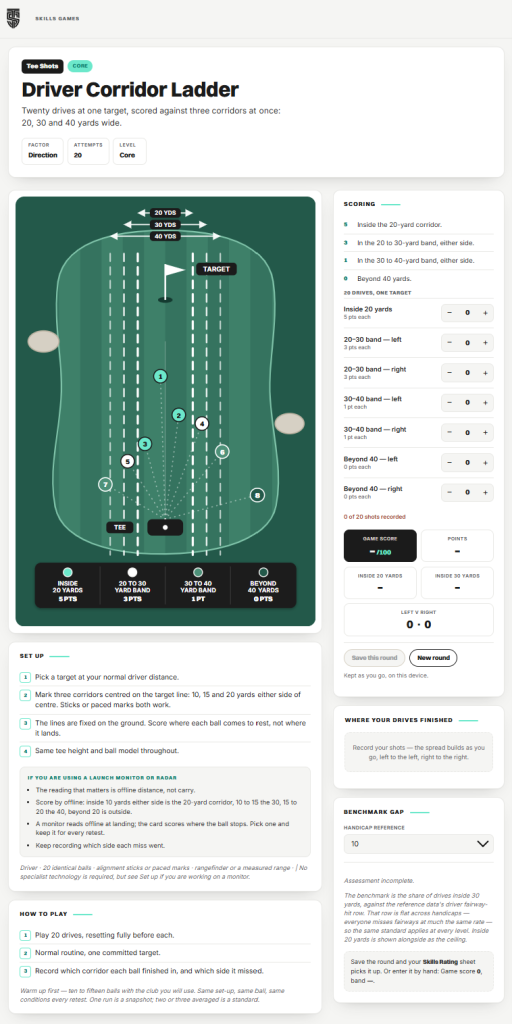
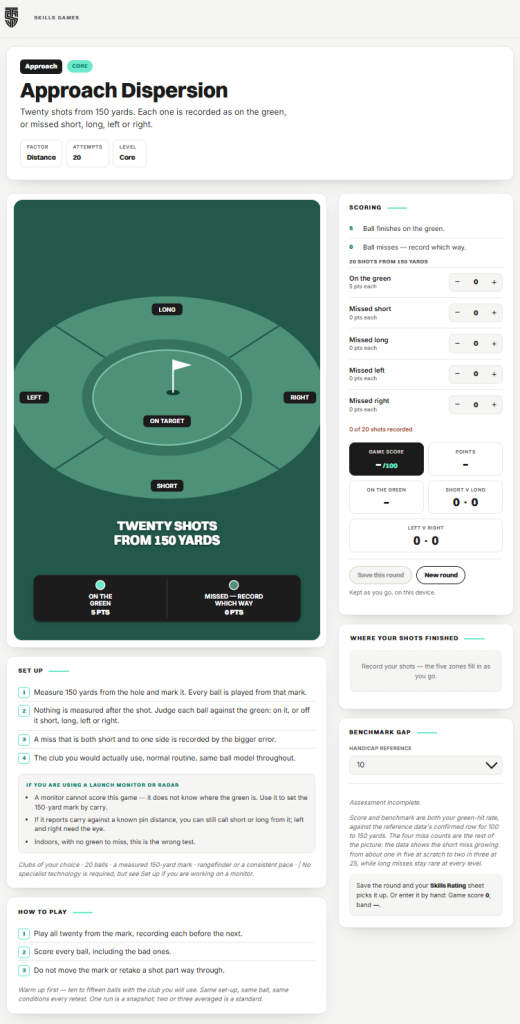
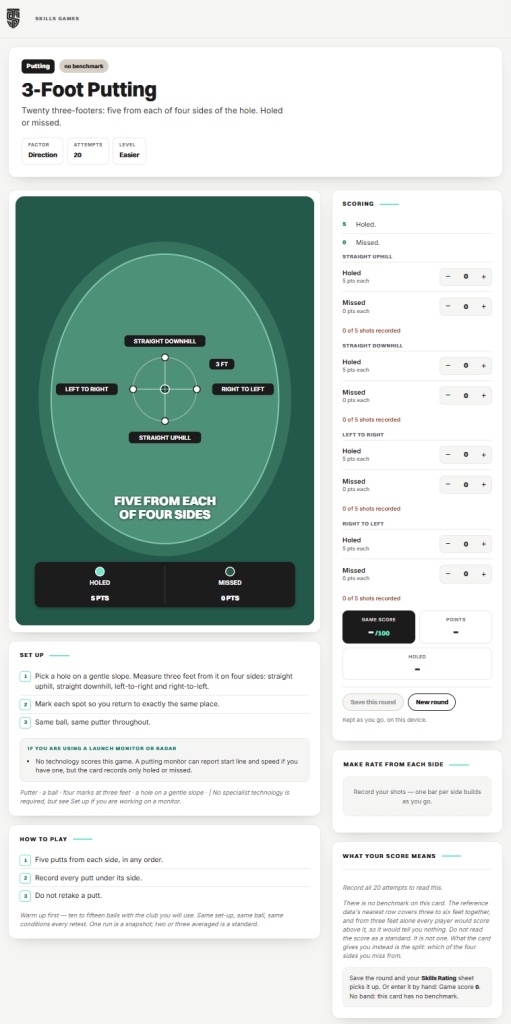
Skills games. Short, scored tests for each part of your game, from driving to putting. They give us a baseline to re-test against.
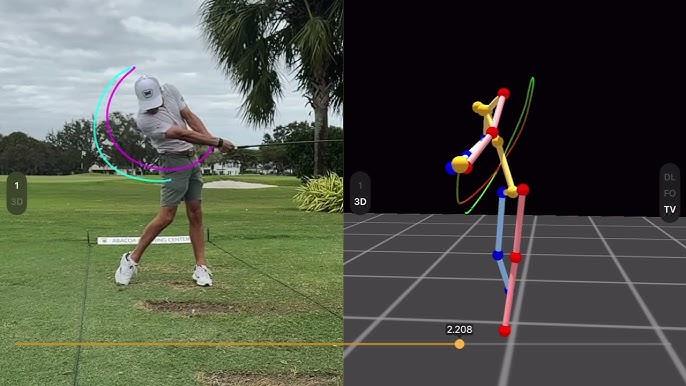
Your swing. Face-on and down-the-line video, plus 3D motion analysis in OnForm.
Each area is then compared against benchmark data for golfers at different handicaps. Most golfers can guess which part of their game is weakest. Very few know how big the gap is, or which part is already playing to a lower handicap.
“He gave me targets yesterday for improved ball speed, launch angle and apex for my drives. I followed his advice and today I was able to report back that I had achieved all 3 targets.”
— Tony Spiers, Google review
Step 4: Pinpoint the priority
We pick the area costing you the most shots right now. One thing at a time.
Trying to fix everything at once rarely works. Choose the right priority and the rest of the game often gets easier.
Most golfers are surprised by how far their putting falls short of what they expect, especially inside 10 feet. The misses are rarely dramatic: a few centimetres wide or short, so nothing about them looks like a big error. Compare that with a driver into the woods, where the mistake is obvious and impossible to ignore. But a subtle miss costs exactly the same stroke, and because it doesn’t feel like a mistake, most golfers never notice it.
Step 5: A plan across four areas
I coach across four areas, and they carry equal weight:
Technique: how you swing the club
Skill: how well you control the ball, including distance, direction and strike
Playing strategy: decisions, club choice and how you plot your way round
Practice strategy: what you practise, how, and for how long
Some problems are swing problems. Many aren’t. The plan uses whichever areas will help you most.
Step 6: Coaching reviews, two videos at a time
Each review is two coaching videos:
The analysis. Your swing with my voiceover, explaining what’s happening and why it’s causing your ball flight.
The solution. Me demonstrating the fix, with the drills to make it happen.
Your drills, skills games and practice plans sit in the members area, so you know exactly what to do in each session.
“He strikes a balance between setting challenging objectives and not overwhelming students with too much information too quickly.”
— Andrew Wood, Google review
Step 7: Support all month
Message me through OnForm with questions, new videos or how a round went. I reply within 48 hours.
You know your game, your time and how things feel over the ball. I bring the diagnosis, the plan and the accountability. We work it out together.
Step 8: Review, re-test, move on
We review progress every month. When a piece of work looks complete, we re-test it with the same skills games and on-course stats we started with.
There’s no fixed date for that. It depends on how much you practise and how well the changes are taking. Once the numbers confirm the change, we move to the next priority.
DO THIS
Before your introduction call, play one round and note three things on every hole:
did your tee shot finish in play?
did your approach finish on the green?
how many putts did you take?
Then film three face-on and three down-the-line swings with a 7-iron. Bring both to the call.
The programmes
Online Performance Coaching — £99 a month
Online consultation and game assessment
Personal improvement plan, updated monthly
Up to two video reviews a month (each one is two coaching videos)
Drills, skills games and practice plans
Messaging through OnForm, replies within 48 hours
Monthly progress review
Online Performance Coaching Plus — £179 a month
Everything above
Up to four video reviews a month
A 30-minute video call each month
Scorecard, stats and tournament review
More detailed performance and practice planning
Priority replies and a monthly accountability review
Quarterly performance report
Single Swing Review — £99
One full review of your swing, no subscription
What makes my coaching different
It starts with your scores, not your swing.
It covers all four areas of improvement, not just technique.
Every review tells you what to do, not just what’s wrong.
Progress is measured against handicap benchmarks and your own starting numbers.
The experience behind it. PGA Professional since 2011, PGA Fellow Coach, Today’s Golfer Top 50 UK Golf Coach every year since 2020, and more than 15,000 golfers coached.
Frequently asked questions
Who is online coaching for? Golfers of any ability who want to improve and will film themselves and practise. Complete beginners may benefit from a few in-person sessions first.
Will I get worse before I get better? No. Ball flight and contact should be the first things to improve. Changes can take time to bed in, but that isn’t the same as going backwards.
Can I combine online coaching with lessons? Yes. If you’re near Shrewsbury, I offer plans that mix lessons at the Shrewsbury School Golf Studio with online support in between.
How long do people stay? As long as it’s helping. My in-person students typically stay 18 months or more.
Start with a conversation
Book a free 15-minute Online Coaching Introduction Call. We’ll talk about your golf, what you want from it, and whether online coaching is the right fit. If it isn’t, I’ll tell you.
See the benchmarks for every handicap from scratch to 25, then use the tally card on your next three rounds to find out what's really costing you shots.
Steve Thomas is a PGA Fellow Coach and has been a PGA Professional since 2011.
He has been named in Today’s Golfer’s Top 50 UK Golf Coaches every year since 2020, writes a monthly feature for the magazine, and has coached more than 15,000 golfers.
He coaches online and in person at Shrewsbury School Golf Studio.